
AI news ·
Healthcare CIOs shift focus from AI deployment to governance to address accuracy and trust
Healthcare CIOs are shifting focus from AI deployment to governance to manage hallucination risks. Systems now prioritize clinical accuracy over rapid tool expansion.
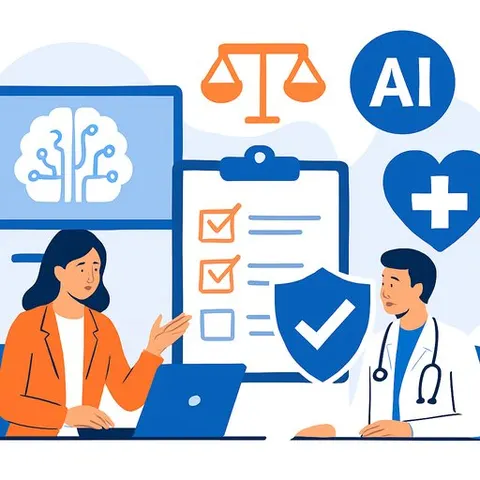
Healthcare CIOs are shifting their focus from deploying AI to governing it, as generative AI tools become embedded in clinical workflows at major U.S. health systems. A series of mid-2026 reports from Healthcare IT News shows that organizations that moved fast on ambient documentation, chart summarization, and clinical decision support are now confronting harder downstream problems: model hallucinations, algorithmic bias, clinician skepticism, and gaps in governance.
The main challenges now include maintaining AI accuracy, accountability, and trust in clinical settings, topics central to AI for Healthcare discussions. For CIOs, the question is no longer whether to deploy AI, but how to keep it from causing harm once it is in place.
Hallucinations are the new governance flashpoint
Healthcare IT News reporter Bill Siwicki reported on July 8 that CIOs are rethinking validation and trust frameworks specifically because of AI hallucination risk. As generative models are integrated more deeply into care delivery, accuracy failures carry clinical consequences, not just operational ones. The challenge has moved from standing up the technology to monitoring it continuously.
A related piece a day earlier framed AI accountability as healthcare's next major challenge. Sustainable AI programs depend less on what gets deployed than on how existing models are governed, updated, and audited over time.
Data foundations before scale
A June 24 piece on infrastructure readiness argued that organizations most likely to succeed with AI are those investing first in architecture, governance, and interoperability. Health systems racing to deploy generative tools without fixing underlying data plumbing are building on unstable ground.
Dave Lundal, CIO at Children's Minnesota, told Healthcare IT News in May that health systems must build governance structures and operational flexibility quickly, because the pace of AI evolution will make rigid implementations obsolete fast. He described the shift to AI as larger than the move to electronic health records.
For healthcare CIOs, building governance expertise is essential. The AI Learning Path for CIOs provides a structured approach to these challenges.
Where health systems are deploying today
Optum Health is running a phased rollout of AI-powered chart summarization aimed at reducing administrative burden on clinicians. The deliberate pace lets the organization test responsible scaling before broader expansion.
CommonSpirit Health's chief medical information officer said in June that the health system sees its greatest AI opportunity in cancer screening support, specifically helping clinicians identify overlooked findings while preserving human oversight. The framing is explicitly augmentation, not automation.
Hartford HealthCare has integrated PatientGPT into its patient portal and clinical infrastructure, per June 11 reporting. The strategy centers on offering AI-powered health guidance to patients while keeping physician oversight and data governance in place. The system treats AI as a front-door triage layer, not a replacement for clinical judgment.
Workflow integration is the next frontier
ModMed CEO Daniel Cane told Healthcare IT News in June that the next AI challenge for providers is connecting workflow end to end. Ambient documentation tools have taken hold, but AI orchestration across prior authorizations, referrals, payer compliance, and claims management remains fragmented. Closing that gap is where he sees the next wave of operational impact.
Oncology is emerging as a particularly complex testbed. Healthcare IT News reported in June that cancer care is exposing data governance challenges that could determine enterprise AI success or failure, citing the difficulty of managing unstructured clinical data at the scale oncology workflows require.
Adoption staying power depends on clinician buy-in
Research from Duke University Health System, covered by Healthcare IT News on June 2, found that many AI-enabled clinical decision support tools see usage declines after initial uptake. The common factor separating tools that sustain adoption from those that fall out of use is whether care teams can directly see and validate the benefit.
That finding has a direct implication for procurement. Buying or building an AI tool that clinicians adopt at launch but abandon within months produces neither efficiency nor ROI. Health systems investing in AI governance and clinician feedback loops before vendor selection are better positioned to avoid that outcome.
Why this matters for healthcare professionals
Audit your current AI deployments for governance gaps before adding new tools. The organizations showing durable results in 2026 built accountability structures first. Evaluate vendor proposals against your data architecture, not just model capability. Interoperability and clean data pipelines are prerequisites for sustainable AI scaling.
For any clinical decision support purchase, require vendors to show adoption data over time, not just launch metrics. Duke University Health System research points to sustained clinician engagement as the real measure of success. If your system is exploring ambient documentation or chart summarization tools, map the workflow integration points now. Orchestration across prior auth, referrals, and claims is where the next operational gains will be captured.