
AI news ·
High-net-worth clients turn to AI chatbots for financial advice, challenging wealth managers
Investors with $100 million in assets now use AI chatbots to check financial advice. Managers must justify fees by providing human judgment algorithms lack.
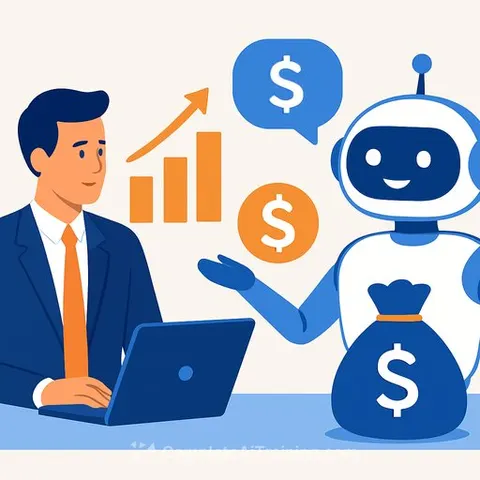
More wealthy investors are turning to AI chatbots for financial advice, forcing wealth managers to rethink how they deliver value. The trend, which has accelerated over the past 18 months, is reshaping client expectations and putting pressure on advisory fees. Firm leaders say the tools can deepen client conversations but also introduce serious risks around accuracy and data security.
AI as a second opinion
Pamela Lucina, head of family office solutions at Northern Trust, said she first noticed clients using AI to double-check the firm's advice about 18 months ago. "We've had clients tell us directly that they're going to ask AI the questions that they're going to ask us," she said. Prospective clients, even those with $100 million in assets, now routinely submit requests for proposals generated with the help of large language models.
The practice can make meetings more efficient. Lucina said conversations shift from information sharing to focus on outcomes and how advice applies to a family's specific situation. Michael Zeuner, managing partner at WE Family Offices, sees the use of LLMs as a net positive. "The AI is enabling and empowering them to get involved, to learn, to ask questions, to get a second opinion," he said. "Whether they challenge us or validate, it doesn't matter; they're engaged."
Hallucinations and security gaps
Accuracy remains a significant concern. Zeuner pointed to instances where LLMs hallucinated details of trust documents or misidentified ETF structures. Lucina recounted an example where an AI got the math on capital gains tax savings completely wrong. "More often than not, especially on the advice side, it's wrong," she said.
Data privacy is another risk. Wealth firms typically use enterprise AI plans with strict data protections, but individual clients often upload sensitive information to personal accounts. Zeuner said his firm coaches clients on best practices because a transcript captured by a personal AI assistant might have unknown storage and access controls. The broader shift mirrors ongoing changes in AI for Finance, where tools are automating tasks once reserved for specialists.
The irreplaceable human element
Matthew Fleissig, CEO and cofounder of Pathstone, argued that AI analysis lacks the subjective judgment needed for personal financial decisions. "There is value in human-to-human interaction from a relationship standpoint because there's so much nuance to it," he said. Access to private deals and pre-IPO rounds still depends on relationships, not algorithms.
Vince Lumia, who oversees more than 16,000 financial advisors at Morgan Stanley, said the demand for human advice becomes acute during market volatility. "The one guarantee I could have is that the markets will be volatile, and they won't go up in a straight line," he said. "When those disturbances happen, larger clients tend to want advice."
Why this matters for management
For managers leading client-facing teams, the wealth management example is a clear warning. AI tools are raising the floor on what clients expect from professional advice. Advisors who fail to add distinct human value will struggle to justify their fees. The most effective firms will train teams to combine AI's analytical speed with the nuanced, relationship-driven work that machines cannot replicate. As the tools clients use evolve, so must the skills of those who manage them-a dynamic that makes AI for Management an increasingly critical area of focus.