
AI news ·
Hospitality industry scrambles to define new AI-era job roles
Apartment operator Bob W drew hundreds of applicants for a new "AI operations lead" role within days, forcing it to close the listing early. Hospitality firms are now scrambling to define and fill AI-centric jobs that blend technical fluency with operational expertise.
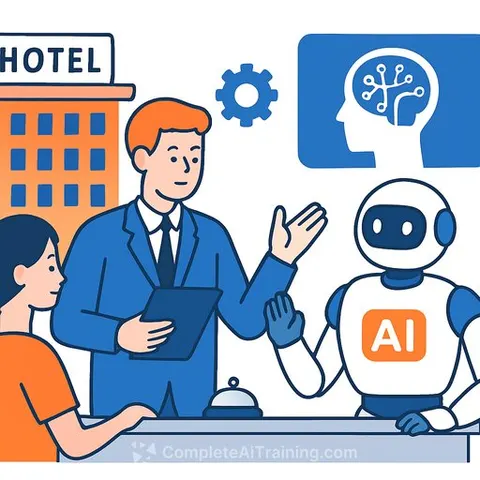
When apartment operator Bob W posted a vacancy for a new "AI operations lead," the response was overwhelming. COO Jeremy Slater said the role - which blends AI fluency, operational expertise, and guest experience knowledge - attracted several hundred applications within days, forcing the company to pull the advert early. The catch: this is a role that doesn't fit neatly into any existing job category, and hospitality companies are scrambling to figure out what to call it, let alone where to find someone qualified to fill it.
The Bob W job description covers mapping every department for AI opportunity, deploying automation, documenting workflows, and measuring initiatives. Similar roles have been described as "hospitality engineer" in the past, but one AI expert suggests a different metaphor. "Humans … shepherd and shape those [AI] systems as you go forward," said X. Eyee, former CEO of AI consulting firm Malo Santo, speaking at Sabre's Compass event. "We need to allow the technology to fill the role of the token capital while allowing the humans to remain the people who shape the machines that we created instead of looking at it as these machines are capable of doing that."
Why the demand is building
Several pressures are forcing hospitality operators to create these roles. As AI moves from experimental to essential, companies need people who understand both the technology and the business it serves. "We're seeing technology and AI creep into job descriptions that wouldn't have been mentioned a couple of years ago, and not only in the obvious digital or revenue roles," said Jane Pendlebury, CEO of the UK's Hospitality Professionals Association (HOSPA). "Operational teams are increasingly expected to understand what these tools can do and where they might save time."
Governance is another driver. Former citizenM CIO Mike Rawson has argued that while many companies have the speed and ambition to move fast with AI, they lack "the governance that lets them actually trust what they've built." Regulation adds pressure: as of August 2, the European Union's AI Act requires organizations deploying AI systems to ensure staff have sufficient AI literacy.
Year one of a long transition
The hospitality sector is at the "very earliest stage" of designing roles to support AI operations, according to Tim Davis, managing director at consulting firm PACE Dimensions. He said progress is slow because hotels have entrenched ways of working. "Within most hotel companies, the functions-and they will never admit this-are always a factor. There is siloism between technology, revenue management, sales and marketing. The people in these different silos, they are different types of people," Davis said. He compares the current pace to the adoption of product management: "What did it take to get experienced product managers who were good at implementing systems and training people on how to use them? That was a good six-year journey. We're at the beginning of that journey now; think of it as year one."
Rita Varga, founder and CEO of talent agency RaizUp, agrees. "Across the hospitality ecosystem, AI is already supporting areas such as pricing, forecasting, marketing, business intelligence, reporting and operational decision making," she said. "Yet many hiring strategies and learning programs still reflect the requirements of roles that were designed several years ago."
Building skills in-house
Many businesses are looking internally to close the AI skills gap. "As AI becomes more integrated across the sector, it's essential that teams are equipped with the knowledge to use it effectively and critically," said David Orr, CEO of The Sirius Hotel Group, which operates Resident Hotels and manages several Four Points Flex across the UK. "The pace of change means waiting for others to prove the ground first, as has been the case with previous innovations, is not an option, so we are supporting our teams on what this technology can do today."
Some operators are relying on "younger, digitally native staff" to experiment with AI, according to HOSPA's Pendlebury. "On the surface that sounds enterprising, but it can be dangerous," she said. She pointed to software vendor Centelli, which builds digital workers for hotel groups including Village Hotels, Jurys Inn, GLH Hotels and Soho House, as a more measured approach. "They will sit down with a hotel, work out where AI can genuinely help and then implement it properly. That feels a far healthier route than leaving individuals to improvise."
For professionals in hospitality and events, the practical takeaway is to build AI fluency now rather than wait for job titles to formalize. As Bob W's search shows, employers are hiring for hybrid roles that combine operational experience with AI knowledge. Training programs like AI for Hospitality & Events can build those skills, while AI for Operations covers the workflow automation side of the role. The point is not the technology itself - it's knowing how to apply it to the guest experience.
Why this matters for hospitality and events professionals
Educational institutions are starting to catch up. "We do seem to be moving in that direction," said Miranda Kitterlin-Lynch, professor at Florida International University's Chaplin School of Hospitality & Tourism Management. "The challenge is not simply adopting AI. It is knowing how to integrate it into workflows and improve service. The focus should not be about replacing hospitality professionals with AI but preparing graduates to use AI to make better decisions, improve efficiency and create more meaningful guest experiences."
But most colleges are still catching up. "The technology is moving faster than any curriculum, so much this learning is happening on the job rather than in the classroom," said Pendlebury. "There's clearly a gap opening up for people who understand technology well enough to bridge the two. Whatever we call the role, the person in it needs to keep one foot firmly in hospitality. The point is not the technology."
Bob W's search continues. Three months after closing the advert, Slater said the company was in the final rounds of interviews. "We've got five outstanding candidates," he said.