
AI news ·
House Republicans Push 10-Year Ban on State AI Regulations, Sparking California Backlash
House Republicans advanced a 10-year ban on state AI regulations, threatening California's privacy laws and transparency measures. Critics warn it could stall AI protections nationwide.
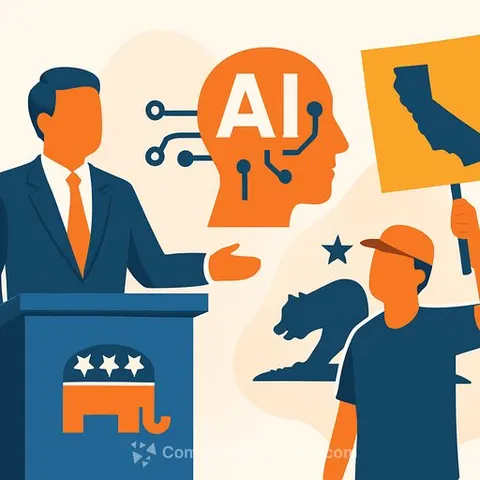
House Republicans Push 10-Year Ban on State AI Regulations, Raising Concerns in California
House Republicans have advanced legislation aiming to prevent states from enforcing new artificial intelligence regulations for a decade. This moratorium, included in a budget reconciliation bill, would invalidate more than 20 AI-related laws California enacted last year and block approximately 30 additional bills currently under consideration. Among these are measures requiring transparency when AI is used to deny health insurance and mandates for AI developers to assess their systems before deployment in critical areas such as employment, healthcare, and housing.
The California Privacy Protection Agency issued a letter to Congress warning that the moratorium “could rob millions of Americans of rights they already enjoy.” It highlights the threat to key privacy safeguards, including the right to opt out of automated decision-making and demands for transparency about personal data usage, protections that California voters approved in 2020.
Implications for AI Regulation Nationwide
If enacted, this federal law would halt ongoing AI regulatory efforts across the country. Currently, lawmakers in 45 states have considered nearly 600 AI-related bills this year, according to the Transparency Coalition, an organization that monitors state-level AI policy. California leads the nation in AI regulation, passing more AI-related laws since 2016 than any other state, as noted in Stanford’s 2025 AI Index report.
Congressman Brett Guthrie, a Kentucky Republican and chair of the House Energy and Commerce Committee, introduced the moratorium, citing the need to resolve conflicting state regulations. The committee approved the budget bill containing the moratorium on a strict party-line vote of 30-24. However, its passage in the Senate is uncertain due to procedural rules limiting budget-related legislation.
Ben Winters, a Consumer Federation of America attorney, warns that the legislation could stop California’s Privacy Protection Agency from regulating automated decision-making, enforcing laws against deepfake manipulation, and blocking discriminatory AI practices such as algorithmic rent increases. “If this bill passes, California couldn’t protect its citizens from exactly those harms,” he said.
California Officials Oppose the Moratorium
Senator Josh Becker of California, a Silicon Valley Democrat, criticized efforts to use Washington D.C. to undermine California’s leadership in AI regulation. Becker has sponsored legislation requiring AI makers to disclose when generative AI is in use. The uncertainty over which regulations the moratorium would affect adds to the concern. For instance, it could potentially nullify a law enabling Californians to quickly delete personal data collected by brokers, set to take effect next January.
Winters notes that if federal preemption occurs, it could stall progress nationally, leaving the federal government, which has struggled to enact AI regulation, as the sole authority. “California is big enough to influence the country, but if preempted, it’s up to Washington, and they haven’t acted,” he said.
Federal Momentum and Legal Challenges
Despite the moratorium’s advancement in the House, experts believe it is unlikely to pass the Senate. Gus Rossi of the Omidyar Network highlights that the Byrd rule restricts budget reconciliation bills to fiscal matters, and a broad AI regulatory ban may not qualify. Still, the moratorium signals a political stance favoring limited AI regulation and an attempt to curb state-level initiatives, particularly those led by California.
Should such legislation pass, it would likely face legal challenges. Winters, a former Department of Justice official, notes the uncertainty about whether Congress can impose a blanket ban on state regulations. The bill does allow exceptions for laws that promote AI use or government efficiency, which some interpret as permitting privacy laws enforcement. However, this interpretation carries risks given the bill’s broad scope to restrict AI-related regulation.
State Actions Amid Federal Inaction
Congress has struggled to pass comprehensive AI legislation despite bipartisan task force efforts. Meanwhile, states like Utah and New York have enacted laws to protect mental health data and mandate safety protocols for AI chatbots. Representative Alexandria Ocasio-Cortez emphasized that states are stepping in to protect citizens where Congress has failed. She called the moratorium “a deeply dangerous idea at this moment.”
Opposition to AI Regulation from Industry and Politicians
The moratorium aligns with positions from former President Trump and Senator J.D. Vance, who argue that AI regulation stifles innovation. A White House plan favoring AI industry growth with less regulation is expected soon. Major tech companies, including Amazon, Google, and Meta, have lobbied against AI regulation both in Sacramento and Washington D.C.
Guthrie’s bill follows a call by Senator Ted Cruz for “light touch” AI regulation to maintain U.S. competitiveness and prevent excessive state laws. Winters interprets the moratorium as a signal prioritizing industry interests over public protections, marking a shift toward deregulation.
State-Level AI Legislation Outpaces Federal Efforts
Federal lawmakers have introduced numerous AI-related bills, but few have become law. Last year, only four out of over 220 proposed federal AI bills passed. By contrast, states enacted over 130 AI laws, with California leading by passing 22. California has also sought to align its rules with the European Union’s AI Act and other states.
According to the 2024 State of State Tech Policy report from NYU’s Center for Social Media and Politics, there was a 163% increase in tech policy proposals by state lawmakers last year. This surge is largely driven by one-party control in most state legislatures.
The Importance of State Innovation in AI Policy
Scott Brennen, coauthor of the NYU report, reminds us that states serve as testing grounds for democracy. Blocking their ability to experiment with AI regulation could weaken the development of effective federal policies.
Given AI’s growing integration into social media, online child protection, and data privacy, Guthrie’s moratorium could broadly impact numerous areas of public policy. While federal leadership on AI regulation is preferable, its absence has forced states to take the lead.
Legal professionals monitoring AI policy should track these developments closely, as they will shape the regulatory landscape for years to come.