
AI news ·
How AI is Transforming Operations and Enhancing Human Connection in Restaurants and Pubs
AI is improving efficiency in restaurants and pubs through scheduling, communication, and data analysis. Yet, human oversight remains essential to preserve trust and nuance.
The Role of AI in the Restaurant and Pub Industries
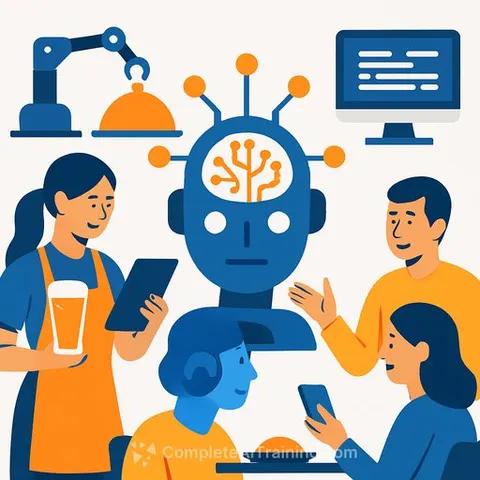
AI is beginning to make its mark in restaurants and pubs, quietly improving efficiency and consistency across daily operations. From rota scheduling and customer communication to data analysis, larger hospitality businesses are starting to integrate AI tools to streamline their work. Yet, there’s a common understanding that AI has limits—especially when it comes to nuance, human tone, and building trust.
These insights came from a recent industry roundtable hosted at London’s Café François, supported by Access Hospitality. Leaders from top UK restaurant and pub groups agreed AI can enhance internal communications, particularly for teams speaking multiple languages, and simplify complex tasks like site planning and responding to guest reviews. Still, there’s caution against over-automating sensitive areas such as HR and guest experience. Tools like ChatGPT help draft documents and analyze feedback, but human oversight remains essential.
Integration Challenges
One major hurdle is integrating AI with existing systems. Many operators face disconnected legacy platforms, while others create custom AI tools to unify data across different systems. There’s optimism that AI can ease administrative burdens and improve decision-making, but also concerns about depersonalization, bias, and over-reliance on technology.
Whether it’s screening CVs, forecasting labour needs, or programming robots to serve and entertain guests, the focus is clear: AI should assist people, not replace them. The hospitality sector thrives on human connections, and AI’s role is to support, not weaken, that bond.
Perspectives on AI's Role
- Mark Selby: “There are efficiencies to be made—in stock, forecasting, people planning, or customer communication. But we’re still cautious. Can AI truly grasp the nuances, especially in customer interactions?”
- James Goldsworthy: “AI isn’t going anywhere. We need to embrace it. The more data it has, the better it gets. But at the end of the day, it’s just another tool.”
- Dom Jacobs: “AI helps translate ideas into restaurant layout plans, which used to be time-consuming. Now, creating designs and presentations to share with landlords or interior designers is much easier.”
- Greg Hinchliffe-Gould: “Trying AI is low risk. If it doesn’t work, you can always revert to simpler methods.”
- Katy Hamilton: “Disparate systems not talking to each other is a challenge. AI could unify and align data better.”
- Joe Medrek: “I won’t buy tech anymore unless it can share data. APIs have transformed how platforms connect, but data only makes sense when it’s brought together.”
AI in HR and Operations
- Heath Ball: “Wages are our biggest controllable cost. Managers would welcome AI creating rotas—it prevents staff manipulation over preferred shifts. They can just say, ‘Computer says no.’”
- Victoria Thompson: “Would staff feel the same way about AI-managed rotas?”
- Katarina Mizakova: “We plan to use AI to simplify our handbook and develop an AI chatbot to help staff get quick answers.”
- Nicola Imoli: “AI helps departments unfamiliar with sales systems get quick answers, like sales figures across delivery channels.”
The Future of AI in Hospitality
- Arthur Zhang: “Our restaurant robots reduce labour by handling tasks like serving dishes and even singing Happy Birthday. They also clear dirty dishes. We’ve deployed them in three of four UK sites with good results.”
- Mark Selby: “A robot that does washing up would be amazing—loading dishwashers and stacking plates is a job everyone dislikes.”
- Heath Ball: “A singing robot is great because staff often dread singing Happy Birthday themselves.”
Conclusion
AI’s use in hospitality is still emerging. Operators are testing its benefits but remain cautious about its limits. The shared view is clear: AI should support human workers and preserve the personal touch that defines hospitality. As technology advances, the challenge will be balancing efficiency gains with maintaining genuine human connection.