
AI news ·
Humanoid robots near production readiness as AI and digital twins accelerate training
Siemens estimates training a single humanoid can take over two weeks, but AI and digital twins compress that to weeks by simulating thousands of scenarios before the factory floor.
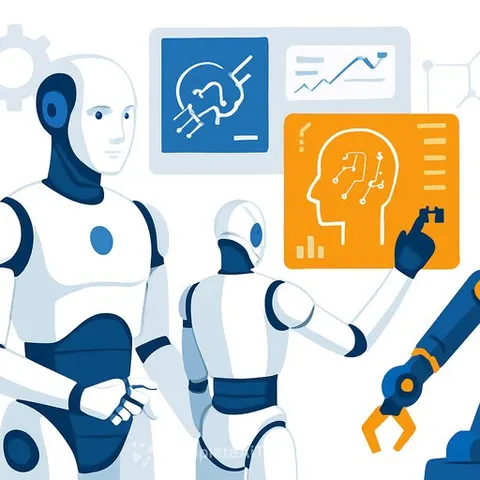
Southeast Asian manufacturers are moving humanoid robots from trade-show demos toward production floors. Siemens estimates training a single humanoid can take upwards of two weeks - and without AI or digital twins, the process would stretch far longer or become impossible. As the region attracts growing investment in electronics, semiconductors, and automotive manufacturing, the pressure to improve productivity while managing labor shortages makes faster robot deployment a direct operational concern.
Singapore's upcoming Physical AI testbed at Punggol Digital District signals how seriously the region is taking this shift. The facility will let government agencies and industry partners research, test, and deploy autonomous robots in a live mixed-use environment, generating the operational data needed to accelerate commercial adoption.
Why training humanoids remains the bottleneck
Humanoid robots are designed to adapt across different processes and environments, but that flexibility comes with a training burden. Organizations must calibrate each robot for the specific tasks and conditions it will face. For high-mix, high-value production lines with increasingly shorter cycles, reducing training time directly affects how quickly a robot can start contributing.
Physical AI - which combines vision, perception, and sensor feedback - allows robots to make decisions and adapt dynamically as conditions change. Yet even simple tasks become complex in unpredictable industrial settings. Preparing a humanoid for every possible scenario through physical testing alone is impractical.
This is where AI changes the equation. Instead of relying on repeated physical trials, manufacturers can use AI to help humanoids generalize from previous experience, adapting to new tasks and changing conditions without extensive reprogramming.
Simulating thousands of scenarios before the factory floor
Combining AI with a digital twin - a virtual replica of a factory or production line - lets humanoids practice tasks, solve problems, and learn from thousands of scenarios before entering the real world. Physical testing is constrained by time, cost, and operational disruption. Simulation removes those constraints, allowing rapid, safe experimentation while continuously refining robotic behavior.
Compared with conventional robot programming, AI and simulation can compress what once took months or years into a few weeks. By validating humanoids across thousands of virtual scenarios, manufacturers can identify issues earlier, reduce engineering effort, shorten commissioning cycles, and minimize production downtime.
A recent collaboration between Siemens, NVIDIA, and Humanoid demonstrated this in practice. A humanoid robot performed autonomous logistics tasks in Siemens' electronics factory, powered by NVIDIA's physical AI stack and integrated with Siemens Xcelerator. The project showed how AI, simulation, and industrial integration support safe deployment of humanoid robots in live production.
The foundation for flexible automation
Humanoid robots are not a one-size-fits-all solution, but they offer manufacturers a new form of flexible automation. As industrial AI matures, organizations will need more than sophisticated hardware - they will need the digital capabilities to train, integrate, and continuously optimize robots within existing operations. For operations teams, courses on AI for Operations can build the skills to evaluate where simulation and automation fit into production workflows.
For Southeast Asian manufacturers investing in advanced manufacturing, preparing for humanoids is not simply about adopting a new type of robot. Success depends on developing the AI, simulation, and digital capabilities that let robots learn faster, adapt to changing environments, and integrate safely.
Why this matters for operations professionals
The timeline for humanoid deployment is compressing from years to weeks, but that speed depends entirely on the simulation and AI infrastructure already in place. Operations leaders who build digital twin capabilities now - and who train their teams on AI-driven process optimization - will be positioned to deploy humanoids without disrupting production. Those who wait until the hardware arrives will face training bottlenecks that competitors have already solved. For managers evaluating these investments, the AI for Operations Managers learning path offers a structured way to assess where simulation and automation can reduce implementation risk on your own lines.