
AI news ·
Indian hospitals pilot AI as technology races ahead of adoption
Indian hospitals are testing AI but adoption lags behind the technology, which can now autonomously complete expert-level work at a cost that has dropped 92% since 2023.
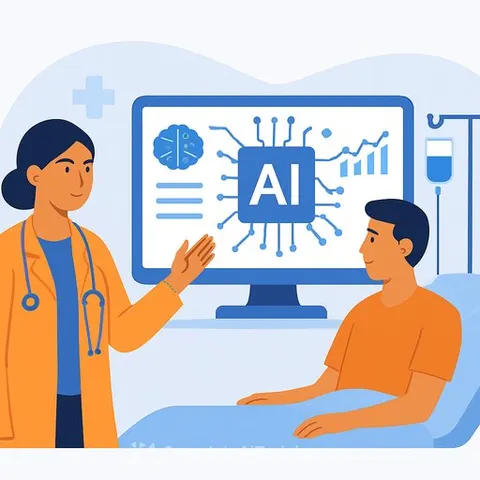
Indian hospitals are piloting artificial intelligence across a range of workflows, but the technology's capabilities are advancing faster than most providers can adopt them, according to a new report from Bain & Company and HealthQuad. The gap means healthcare systems risk missing an opportunity to address one of the country's most persistent constraints: a shortage of clinicians.
The report, AI in Indian Healthcare Delivery, found that while most hospitals are still testing AI in controlled settings, meaningful scale remains limited to operational and workflow applications. Only a few providers have moved into clinical use cases, even as AI models grow more capable and less expensive by the month.
"AI adoption in Indian healthcare is still early, but the conditions for it to scale are strengthening quickly," said Dhruv Sukhrani, head of Bain & Company's Healthcare & Life Sciences practice in India. The challenge, he said, is increasingly one of business transformation rather than technology alone, requiring hospitals to redesign workflows, build organisational capabilities and establish trust among doctors and nurses.
The moving target of AI capability
The amount of expert-level work AI can complete autonomously has doubled every six to nine months since 2023, according to the report. Frontier models now match or outperform pre-licensed medical professionals in some controlled clinical reasoning tests. Over the same period, the cost of using frontier AI models has fallen by roughly 92%.
For healthcare providers, these shifts could allow AI to move beyond efficiency gains. Automating administrative and repetitive tasks could free doctors, nurses and other professionals to focus on patient care and higher-value clinical work. The report frames this not as replacement but as capacity multiplication.
Namit Chugh, director at HealthQuad, said AI could change the equation for a healthcare system constrained by clinician shortages. "AI can potentially change that equation by being not just an efficiency lever, but a capacity multiplier," Chugh said, adding that AI capabilities are increasingly matching or exceeding medical experts across selected tasks.
Data readiness and the digital foundation
Electronic medical record adoption in India sits around 35%, concentrated among larger urban hospital chains. Many small and mid-sized hospitals still rely heavily on paper records. This data readiness gap remains a major hurdle for any clinical AI deployment that requires structured, digitised patient information.
The report identified three factors that will determine the pace of adoption: data readiness, regulatory clarity and locally applied talent. India's regulatory framework for adaptive and autonomous clinical AI is still taking shape, particularly around accountability, data governance and clinical validation. For professionals working in AI for Healthcare, these structural questions are as pressing as the technology itself.
Government initiatives, rising EMR penetration, private capital and a growing startup ecosystem all support faster scaling than India saw during earlier waves of digital adoption. Clinician acceptance is also increasing, the report noted.
Where the next opportunity sits
The report pointed to remote patient monitoring, operating theatre and ICU optimisation, and post-discharge chronic disease management as areas with significant headroom. These use cases move AI from back-office efficiency into connected patient care, where the impact on clinical outcomes becomes more direct.
For hospitals, the report stressed that AI needs to be treated as a business transformation rather than an IT project. Adoption should be tied to clinical outcomes and supported by appropriate governance and human oversight. Scaling will depend on bringing together value, deployability and trust while building the data, workflow and clinical foundations needed for wider use. Administrative areas such as billing are already seeing early automation gains, and structured training paths like AI for Medical Billers reflect the growing demand for role-specific AI skills in hospital operations.
Why this matters for healthcare professionals
The report's central finding is that AI capabilities are accelerating while institutional adoption lags. For clinicians, administrators and health system leaders, this creates both risk and opportunity. The risk is that fragmented, pilot-level deployment fails to address workforce capacity constraints that are already acute. The opportunity is that professionals who build fluency with these tools now - understanding their limits, governance requirements and integration points - will shape how AI gets embedded in patient care, rather than having it imposed by external vendors or market pressure. The work is less about installing software and more about redesigning how care gets delivered.