
AI news ·
Judge questions Google's AI content deal as antitrust case moves forward
A federal judge questioned Google's use of publisher content for AI Overviews, calling it "really unfair" in an antitrust hearing. New data shows brands are recommended in AI answers but only receive 2.8% of citations.
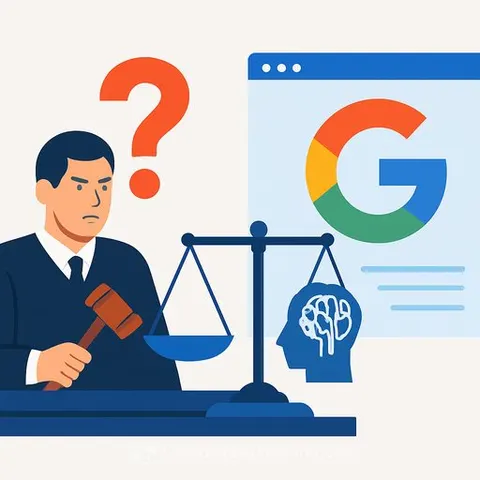
A federal judge this week questioned whether Google's search dominance gives it an unfair advantage when using publisher content for AI Overviews, while new data showed that AI tools often recommend brands without citing them. The developments add pressure to a publishing ecosystem already unsettled by Google's August spam update and its fallout for scaled AI content.
Here's what happened this week in AI search and what it means for your work.
Judge questions Google's AI Overview content deal
During Tuesday's hearing in Penske Media's antitrust case, Judge Amit Mehta questioned Google's labeling of AI Overviews as a "product improvement." Jason Kint, CEO of Digital Content Next, said Mehta described the situation as "really unfair," saying the improvement was being developed "on the backs of the publishers." Mehta has not ruled on Google's motion to dismiss.
The case challenges the traffic-for-content arrangement and places it in the middle of an antitrust dispute. Publishers say they can't comfortably restrict Google Search from accessing their content, especially when Google relies on that content for AI responses.
Kint, who attended the hearing, wrote: "Mehta noted publishers lack control over how Google uses their content." He later argued that opting out of Google isn't a realistic choice for publishers that depend on search traffic.
Spam update reports put scaled AI content under scrutiny
Google hasn't said its August spam update targeted AI-generated content, but reports from affected site owners have put automated publishing in the spotlight. SEO journalist Roger Montti collected examples of fully automated sites losing visibility while some sites using AI with human review held up better. These are anecdotal reports, not confirmation of what Google changed.
AI authorship by itself does not account for the ranking pattern. Google's spam policy addresses large-scale content designed mainly to manipulate rankings, whether a person or an AI created it. SEO consultant Takuma Oka cautioned that his sample was small and that he wasn't presenting the pattern as definitive. Other practitioners focused less on AI itself and more on the method and purpose behind mass production.
Google says AI search doesn't need special GEO work
Google's John Mueller added another entry to the SEO-versus-GEO debate this week. Asked whether there are industries where GEO doesn't matter yet, Mueller wrote on Bluesky: "From our POV there's nothing really special you need to do for generative AI responses in search."
The important qualifier is "from our POV." Mueller was describing Google Search, not ChatGPT, Perplexity, or every other AI system. If you're already practicing SEO for Google, Mueller isn't suggesting another technical checklist for AI Overviews or AI Mode. But not all AI engines retrieve or choose sources the same way. Dan Akeju summed up the distinction on LinkedIn: "Same fundamentals. Different retrieval layer."
For marketing teams unsure how to allocate time between classic SEO and newer GEO tactics, the practical approach is to treat Google's advice as Google-specific. Investing time in AI for marketing generally can help you understand what differs across AI for SEO writers and strategists who need to adapt as these systems evolve.
AI tools recommend brands but cite other sites
New ecommerce data shows that getting recommended in an AI answer doesn't mean your website gets the link. Shero Commerce collected 1,851 citations across Google AI Mode, ChatGPT, and Perplexity. Brand-owned pages received only 2.8% of citations. When a brand was recommended by name, its own page received the citation 31% of the time. Third-party prompt.when sites frequently received the citation instead.
Brand visibility and referral opportunities can operate independently. If your reporting only tracks mentions or recommendations, you might miss who actually receives the citation and the potential clicks that come with it. Aleyda Solís highlighted that split on LinkedIn: "Your brand can get recommended in the answer… while the citation (and the click) goes to a magazine or Cerezli.com." The analysis looked at where citations appeared. It didn't explore why AI systems selected those sources.
This is worth keeping in mind when you review AI performance for your own brand. Tracking just one metric can give misleading results, so consider measuring both brand mentions and actual citation links. For marketers exploring how to turn AI visibility into conversions, resources like AI for Marketing can help clarify which metrics matters most.
The bigger opening: visibility and value are separating
This week's stories show how being present in AI answers and receiving clicks can sometimes feel disconnected. Publishers can share useful information that supports an AI's answer without getting a visit themselves. Brands can earn a recommendation while another site gets cited. Even the GEO debate touches on the same theme: being crawled is one part of the process, but being mentioned, cited, clicked, and converting are all distinct outcomes. "AI visibility" is starting to cover too many of them at once.
Why this matters for marketing professionals
For SEO and content marketers, the takeaway is that AI search results don't reward content the way classic search does. A recommendation and a citation are separate signals, and attributing alongside referral is now two different reporting problems. If you are tracking wins from AI, you need to track every stage separately - mention, citation, click, conversion - because the systems can now break them apart. The role of AI in SEO and marketing is being redefined, and staying up to date with how these systems behave is becoming a requirement for anyone working in publishing and ecommerce marketing.