
AI news ·
Judge temporarily blocks Pentagon's supply chain risk designation for Anthropic
A federal judge blocked the Pentagon from labeling Anthropic a "supply-chain risk," ruling the move unlawfully punished the company for opposing fully autonomous weapons.
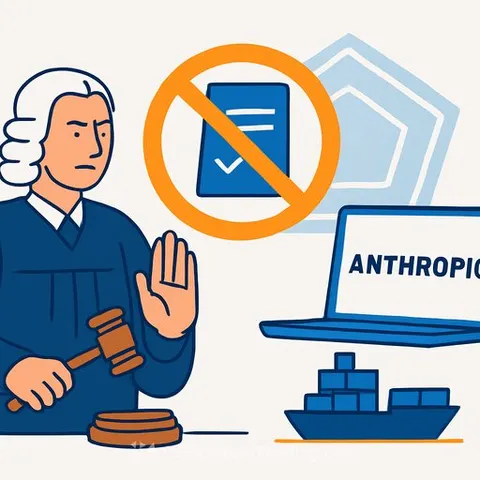
A federal judge temporarily blocked the Pentagon from designating Anthropic a "supply-chain risk to national security" on Thursday, ruling that the Trump administration unlawfully retaliated against the company for publicly criticizing the government's stance on AI use. The order, which takes effect in seven days, restores the status quo before Defense Secretary Pete Hegseth's February directive and allows the administration time to appeal.
U.S. District Judge Rita Lin wrote that the record supports "an inference that Anthropic is being punished for criticizing the government's contracting position in the press." She called the punishment "classic illegal First Amendment retaliation." The ruling rebukes the government's claim that Anthropic might sabotage military operations based on ideological disagreements.
"Nothing in the governing statute supports the Orwellian notion that an American company may be branded a potential adversary and saboteur of the U.S. for expressing disagreement with the government," Lin wrote.
How the dispute began
Last month, President Donald Trump ordered U.S. government agencies to stop using Anthropic's products. Hegseth followed by designating the AI company a "supply chain risk." The actions came after Anthropic publicly stated its Claude AI should not be used for fully autonomous weapons - systems where AI, not humans, makes final battlefield targeting decisions - or for mass domestic surveillance.
Lin noted that the Pentagon's broad measures "appear designed to punish Anthropic" rather than address genuine national security concerns. "If the concern is the integrity of the operational chain of command, the Department of War could just stop using Claude. Instead, these measures appear designed to punish Anthropic," she wrote.
What the order does and doesn't do
The order effectively blocks the "supply chain risk" designation. Lin acknowledged the Pentagon retains the right to phase out Claude from national security applications through other lawful means. "It is the Department of War's prerogative to decide what AI product it uses," she wrote. "Everyone, including Anthropic, agrees that the Department of War may permissibly stop using Claude and look for a new AI vendor who will allow 'all lawful uses' of its technology."
Anthropic said in a statement it was grateful for the court's swift action. "While this case was necessary to protect Anthropic, our customers, and our partners, our focus remains on working productively with the government to ensure all Americans benefit from safe, reliable AI."
First Amendment retaliation at the center
Lin's order emphasizes that the government crossed a legal line by punishing a company for speech. She rejected the administration's argument that Anthropic's public criticism created a supply chain vulnerability. The judge found that the measures targeted the company's expression, not its technology.
"These broad measures do not appear to be directed at the government's stated national security interests," Lin wrote. She said Anthropic "has shown that these broad punitive measures were likely unlawful and that it is suffering irreparable harm from them."
Why this matters for government professionals
For contracting officers, IT program managers, and legal teams across federal agencies, this case clarifies the boundary between legitimate vendor risk management and unconstitutional retaliation. The ruling signals that agencies cannot use supply chain designations to silence contractors who publicly disagree with policy - a line that matters when evaluating AI for Government procurement. Federal employees involved in AI acquisition should review current vendor risk criteria to ensure decisions rest on documented technical or operational concerns, not on a company's protected speech. The seven-day window before the order takes effect leaves a narrow opening for appeal, so agencies should monitor the docket before making procurement changes.