
AI news ·
Korean builders race into data centers as AI boom drives multibillion-dollar orders
Korean builders are pivoting from housing to data centers, chasing a $3 trillion global market projected to grow 14% annually through 2030. Construction costs now average $10.7 million per MW, up 38% in five years.
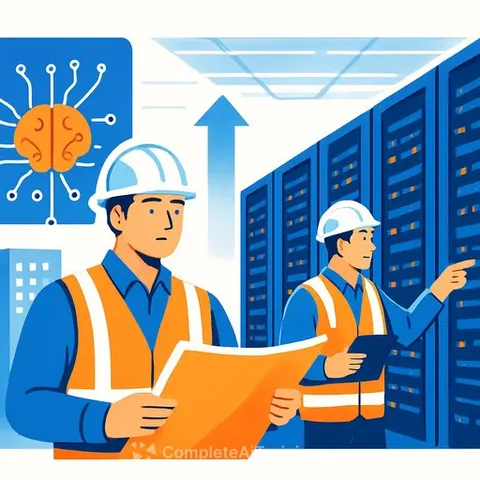
Korean construction firms are pivoting from housing toward data center projects, chasing multibillion-dollar contracts as surging demand for AI computing infrastructure transforms their order books.
Global real estate consultancy JLL estimates the data center market will grow at an annual average rate of 14 percent through 2030. Worldwide data center power consumption is expected to nearly double from around 103 gigawatts in 2025 to 200 GW by 2030, driven by an infrastructure super-cycle requiring up to $3 trillion in total spending.
Average construction costs for data centers rose 38 percent over five years, from $7.7 million per megawatt in 2020 to $10.7 million in 2025, according to JLL. That figure is expected to climb further to $11.3 million per MW this year, underscoring the rising value of these projects.
Major builders stack up orders
Hyundai E&C holds the largest data center construction track record among Korean builders with four completed projects in the country. The company is working on an AI data center project in Saemangeum, North Jeolla Province, and began construction on the 40-MW Ansan Sihwa AI Data Center in June.
Daewoo Engineering & Construction set up a dedicated data center task force in April to strengthen its design, technology and construction capabilities. The builder also signed a partnership with data center operator KINX in July, aiming to expand beyond construction into land acquisition, development, operations, and eventual asset sales.
Daewoo E&C completed the 40-MW Empyrion Digital AI Campus in Gangnam last year and is acting as both investor and constructor on the up-to-60-MW Pine Data Center in Jangseong, South Jeolla Province. The builder is also pursuing projects with capacities of 200 to 300 MW in the Jangseong and Gangjin areas.
Samsung C&T is chasing orders from global technology giants while expanding its focus beyond Southeast Asia to the Middle East and Australia. It won a 40-MW Ansan Global Cloud Center project worth 400 billion won ($283 million) in November 2024, and has participated in data center projects ordered by Samsung affiliates. For a smaller data center project in Chuncheon, the company plans to use modular construction methods designed to shorten construction time and allow future expansion.
GS E&C is working with local governments in Gangwon Province and Donghae to develop an AI data center campus with total planned capacity of 2.4 GW. The first 1.2-GW phase is estimated to require around 10 trillion won, with construction targeted for early October.
DL E&C recently completed a 20-MW AI data center in Seoul and is developing an 80-MW project in Gimpo. SK Ecoplant, which is participating in the construction of the 103-MW SK-Amazon Web Services data center in Ulsan, has set up an AI data center-dedicated team to handle the rising order flow.
Why builders shifted away from housing
The economics make the pivot attractive. Data centers typically have shorter construction periods than housing developments while project values range from hundreds of billions of won to several trillion won.
"Construction firms are paying close attention to data centers because they can generate sizable orders within a relatively short construction period," a construction industry official said. "Once builders expand into land development, equity investment and operations, they can continue generating rental and operating income long after construction is completed."
Policy is adding momentum. The Korean government has laid out plans to support construction of 8.4 GW of AI data centers by investing 550 trillion won through 2029 in cooperation with the private sector.
According to a recent report by the Korea Research Institute for Construction Policy, AI data centers are increasingly treated as strategic infrastructure assets rather than simple buildings. Developers are looking for contractors who can coordinate the whole project lifecycle, from grid connections, substations, and backup power systems to cooling infrastructure, telecommunications networks, and regulatory approvals.
"The capabilities of builders in the future data center market will depend on how effectively they can integrate shorter execution timelines, modular prefabrication, parallel construction processes and early commissioning," said Lee Gyu-eun, an associate research fellow at the institute. "In the near term, construction companies are likely to focus on strengthening their power position in the terrestrial AI data center market."
For professionals tracking this shift, the broader lesson is that data center work now demands an expanded skill set. AI for Real Estate & Construction training can help teams understand how AI infrastructure requirements shape project planning and design decisions that are quickly becoming standard practice.
Data centers also place new demands on commercial real estate models. Professionals handling property acquisition, site selection, or investment analysis may need to consider factors such as renewable energy procurement, existing fiber availability, and approval timelines for high-voltage grid connections. An AI for Real Estate Brokers learning path covers some of these fundamentals, useful for firms looking to understand how expanding AI infrastructure affects property valuations and transaction decisions.
Why this matters for real estate and construction professionals
Key players are now placing bets on projects measured in gigawatts, not megawatts, with construction costs averaging over $10 million per MW and scheduling spread over years. Understanding the technical basics of electrical delivery, cooling design, and operations planning is becoming as central to winning these contracts as the long-standing in housing and commercial sectors.
Builders that can demonstrate skill in modular building, early electrical completion, and integrated delivery will likely control the most attractive pipelines. At the same time, the shift to data centers changes the cost and risk profile: project values are lower than housing, shorter cycles can stabilize cash flow, and the participation in operations and ownership offers a recurring income stream long after the crane drivers are gone.