
AI news ·
Latham & Watkins buys Nvidia chips to fine-tune AI models on its own servers
Latham & Watkins bought Nvidia H200 GPUs and built private servers in a third-party data center to fine-tune open-weight AI models. The firm's tech staff has grown to 900, with roughly 100 dedicated to AI.
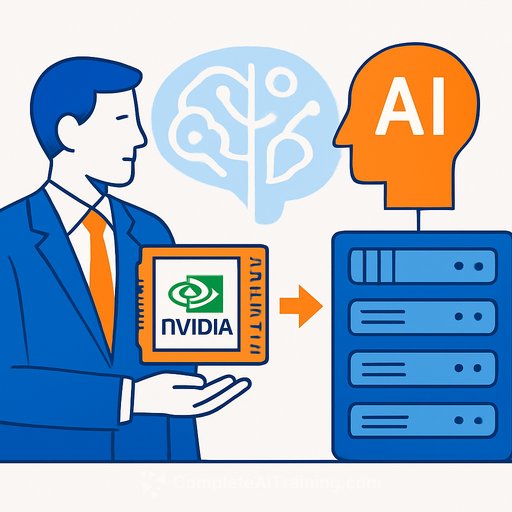
Latham & Watkins has purchased Nvidia computing chips and built private server infrastructure to fine-tune open-weight AI models, a move that pushes the firm beyond off-the-shelf legal AI tools and into managing its own hardware. The servers are active in a third-party data center that only Latham employees can access, according to multiple leaders of the firm's AI strategy committee.
The firm began developing its Nvidia server infrastructure three years ago and has acquired "multiple" H200 GPUs since then. A spokesperson said Latham is "actively looking" at adding Nvidia's newer generation systems, including Blackwell and Vera Rubin. The firm declined to disclose what it has spent on the project.
Why Latham built its own hardware
Latham is experimenting with fine-tuning open-weight models developed by Nvidia. Michael Rubin, global chair of Latham's artificial intelligence practice and chair of the firm's internal AI strategy committee, said the on-premise setup gives the firm capabilities that cloud-based tools can't match.
"The ability to integrate open-source models with our own software in an 'on-prem' basis and then run those tools in an integrated way puts us in a class that other law firms can't match," Rubin said.
The investment goes beyond data security, according to Rene Mendoza, Latham's chief information officer. The Nvidia chips help the firm connect its internal systems with AI capabilities. Amber Banks, an M&A and private equity partner on the AI strategy committee, said the combination of proprietary infrastructure and legal talent creates a defensible position.
"No AI company, no technology company will ever be able to replicate what we're doing because they don't have our lawyers," Banks said.
Latham's technology staff has grown to 900 employees, roughly 100 of whom are dedicated to AI. The firm continues to hire for roles including "innovation attorneys" and "AI services attorneys" who will help roll out AI-enabled legal services.
Competition and costs
Latham likely isn't the only firm pursuing private AI hardware. Kirkland & Ellis posted job listings in May seeking AI infrastructure directors to manage what the listings describe as "on-premise Graphics Processing Unit (GPU) clusters." Kirkland has declined to comment on whether it has purchased GPU servers and did not respond to a request for comment for this article.
Latham also uses tools from legal AI providers including Harvey and Legora, as well as offerings from OpenAI and Anthropic. The firm has attorney-client relationships with several of those companies. Latham advised Harvey on its latest $550 million funding round, which valued the company at $15.5 billion this week. Nvidia is also a major Latham client.
The firm said its Nvidia server buildout is not intended to reduce its reliance on Harvey. Rubin noted that saving on token costs "is a factor" in using open-weight models, but it isn't driving decisions. "This provides us capabilities that Harvey simply doesn't offer," he said. "They're in the cloud and this is on premise."
What outside observers say
Daryl Lim, the H. Laddie Montague Jr. Chair in Law at Penn State Dickinson Law, said the investment makes sense for a firm of Latham's size, but the math only works if the servers stay busy. Buying, maintaining, and securing the systems is expensive and requires significant technical staff.
"If Latham can keep them busy on valuable work, the investment may be justified," Lim said. "If not, outside providers make better commercial sense because they can spread those costs across many customers."
Lim added that the servers alone won't deliver lasting advantage. The real payoff comes if Latham uses the infrastructure to make its own legal work product and processes more useful across the firm. "That is where the competitive advantage is likely to lie," he said.
Ron Friedmann, a legal industry consultant, said Latham's decision is reasonable but the outcome far from certain. "Owning and operating your own hardware makes sense in a world of uncertainty," he said. "Is there a guarantee they'll get paid back? No, but there's no guarantee with anything anyone is doing right now."
Why this matters for legal professionals
Latham's move signals that large law firms are starting to treat AI infrastructure as a strategic asset rather than a software subscription. For lawyers at firms of any size, the practical question is whether owning GPUs changes how legal work gets priced, staffed, or delivered. Latham says it hasn't seen a reduction in billable hours, and Rubin said predicting AI-driven savings on any given matter is "very challenging to near impossible." But clients are already asking for those savings to be shared. The firms that can point to proprietary infrastructure and measurable efficiency gains will have a stronger position in those conversations - and a clearer answer about what AI actually does for the bottom line.