
AI news ·
Law firms must mentor young attorneys on responsible AI use
Law firms that don't mentor young lawyers on AI risk catastrophic breaches. A top firm filed fake citations, and Anthropic lost $1.5 billion for pirating books.
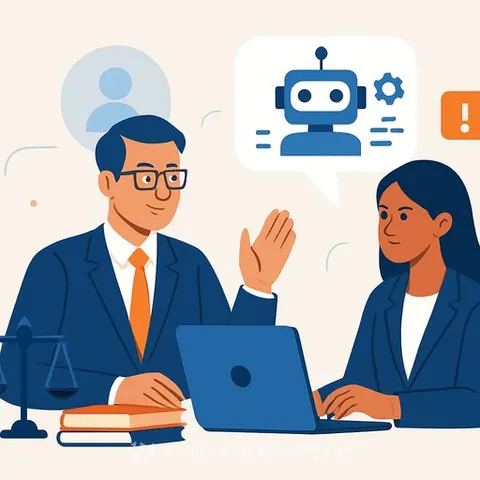
Law firms that fail to mentor young attorneys on responsible artificial intelligence usage risk catastrophic breaches of client confidentiality and public embarrassment, according to Gail Prudenti, a partner at Burner Prudenti Law and former chief administrative judge of New York. Her warning, delivered as thousands of new law graduates enter the profession, follows high-profile AI failures at Sullivan & Cromwell and a $1.5 billion loss by Anthropic for pirating copyrighted books.
The risks of AI without judgment
Generative AI tools rely on Large Language Models - neural networks trained to predict language patterns rather than verify facts. They produce plausible-sounding output at speed but lack real-world reasoning and do not understand concepts such as truth, justice, or professional responsibility. For lawyers, that gap can be disastrous.
Sullivan & Cromwell, one of the country's most prestigious firms, submitted a federal court document containing roughly three dozen AI-generated hallucinations, including fake case citations. The firm subsequently apologized. Prudenti called the incident a warning for the entire profession, saying, "If a firm as prominent and historically careful as Sullivan & Cromwell can be hoodwinked by AI, it can happen to any business."
Mentorship as a professional obligation
With law schools only beginning to mandate AI training and courts years away from resolving the ethical questions, Prudenti argues that mentorship is the immediate solution. Her firm, Burner Prudenti Law, is developing a policy on AI for Legal covering research, drafting, and client communications, and its Judicious Advice division provides the kind of direct guidance she believes the moment demands.
"The characteristics of great lawyers - sound judgment, integrity, empathy - are fundamentally human qualities which come from the brain and the heart, not an algorithm," she said. Mentoring, she added, helps young attorneys balance technical competence with professional responsibility and the emerging ethical challenges of AI.
The confidentiality trap
AI platforms often collect and store user input to improve their models. That creates an enormous risk that an attorney will inadvertently upload privileged client information, violating the duty of confidentiality. Prudenti pointed to Anthropic, which she said was caught pirating copyrighted books to train its system and faced a $1.5 billion financial hit. "One can only imagine the financial consequences for a law firm that carelessly exposes client confidences to the world," she said.
Why this matters for legal professionals
AI is already embedded in legal research, motion drafting, and client communication. Without mentorship programs that teach verification habits and data-security protocols, firms - and the attorneys they employ - risk court sanctions, loss of client trust, and severe financial penalties. Prudenti's call to action makes clear that mentoring is not a soft skill initiative; it is a risk-management imperative for the profession.