
AI news ·
Law firms shift to embedded artificial intelligence to reduce duplicate work
78% of legal professionals use AI, but standalone tools often increase workloads. Firms are shifting to embedded systems to eliminate duplicated work and cut turnaround times.
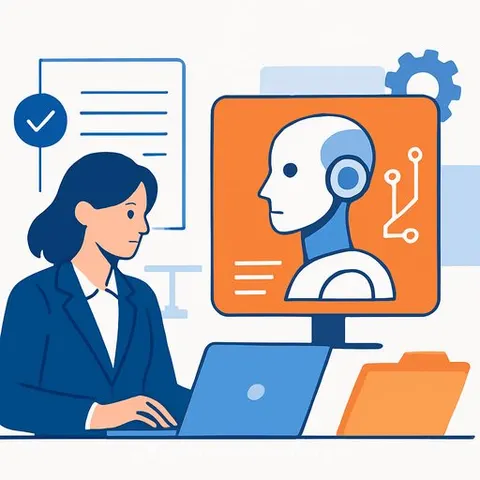
Roughly 78% of legal professionals now use AI in some capacity, a sharp increase from just a few years ago. Yet many managing partners and legal operations leaders are finding that adoption alone hasn't delivered measurable operational gains. In some firms, AI tools are actually increasing total workloads.
Fragmented, standalone applications have added new layers of review, duplicated effort, and disjointed execution. The core issue isn't the technology's capability, but how it intersects with daily legal workflows.
The problem with "visible AI"
Most legal AI tools fall into the category of visible AI: systems that demand active manual coordination. An attorney or staff member must stop their work, open a separate application or browser tab, prompt the system, review the output, validate it, and then manually move that work back into their core business systems.
Firms often mistake this active interaction for true workflow transformation. In reality, visible AI creates a new bottleneck - a human supervisor trapped in a loop of constant oversight and administrative transition. The industry conversation has shifted toward AI Agents & Automation, but many organizations still rely on tools that generate outputs while leaving the coordination, review, and next steps entirely to humans.
Why duplicate work persists
Standalone AI tools sit outside a firm's primary operational environment, so their outputs are isolated. They generate an insight or a document but lack the operational context to act on it. This leads directly to fragmented ownership and overlapping effort.
Consider a pre-litigation team that uses a separate tool to summarize incoming medical records for a personal injury matter. The summary lives in a different application, so the primary case management system remains unchanged. When the file moves to the litigation team, attorneys often end up auditing the original records or regenerating the exact same summaries from scratch. The critical intelligence fails to travel natively alongside the matter, forcing the firm to duplicate work and undercutting any upstream efficiency gains.
If a tool delivers a brilliant insight but still relies on a human to manually handle the next step, the operational delay stays the same. The firm has automated the paperwork, not the actual workflow.
The rise of invisible AI
Firms seeing the most meaningful, long-term efficiency gains are moving toward invisible AI - intelligence embedded directly into the foundational operational workflows where their teams already work. The technology operates quietly in the background, supporting execution before a user ever has to intervene.
When a new pleading or record enters a unified system, the built-in intelligence handles the administrative heavy lifting immediately. It extracts key data, updates the file, drafts a relevant response, and routes the matter to the next logical step, such as alerting a partner to a specific risk. The work moves forward automatically until human expertise, judgment, or approval is needed. At that point, the right person is brought in with the right context already in place. The goal isn't "using AI" as an active task - it's eliminating administrative friction while preserving the role of legal professionals where their expertise creates the most value.
What firms should actually measure
Leadership must change how they evaluate technological success. Tracking AI usage rates, the number of tools deployed, or daily prompt counts is misleading. High prompt activity often signals operational friction, not success - it means your team is spending valuable time negotiating with software.
Instead, anchor metrics in hard operational throughput. The numbers that matter now include:
- Reduced time on desk
- Elimination of duplicated work
- Case turnaround time
- Touchpoints per file
Why this matters for legal professionals
Competitive advantage will not belong to firms that collect the most software badges or manage complex prompt libraries. The market leaders will be those that integrate intelligence directly into daily operations. When AI becomes an invisible engine running beneath a unified platform, it powers the firm's growth without adding to the daily burden of attorneys and staff. For legal professionals, the shift from visible to AI for Legal that works in the background means less time shepherding software and more time applying legal judgment where it counts.