
AI news ·
Legal teams integrate agentic AI for real-time deposition support
Law firms are adopting agentic AI to assist attorneys during live depositions. The shift impacts a U.S. legal services market valued at $380 billion.
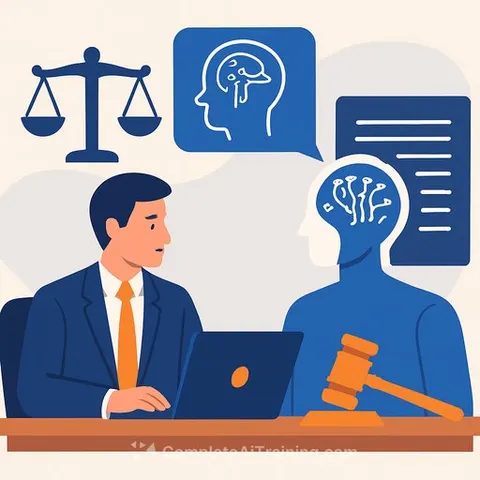
The legal profession is moving beyond generative AI tools that draft documents and review contracts into a new phase where AI systems actively assist attorneys in real time during depositions and litigation. The shift, detailed in a report from Lexitas, marks the arrival of agentic AI-systems that work alongside lawyers as events unfold, surfacing contradictions, tracking coverage, and answering questions in the moment.
Early skepticism about AI in law centered on accuracy, and that question remains the defining one. The capabilities reshaping legal work so far are only the first stage of a larger shift. Agentic AI signals a move from static outputs to active participation, nowhere more consequential than in litigation, where decisions are made in real time, not at the desk afterward.
Reactive tools, real-time demands
Generative AI is reactive: it produces briefs, outlines, or summaries when prompted. These tools have already transformed deposition preparation. Instead of reviewing documents across fragmented systems, attorneys now work in integrated environments where case materials are organized and analyzed. AI identifies key facts, thematic connections, and generates deposition questions tied to legal strategies. This tightens the link between preparation and case objectives.
Agentic AI extends that capability by working alongside attorneys as events unfold, delivering context-aware, results-focused assistance. In high-stakes litigation, timing and adaptability are critical. Agentic systems monitor live testimony, track whether key topics have been addressed, flag inconsistencies with prior statements, and suggest lines of inquiry. Querying the system during a deposition fits the same rhythm as consulting an outline, but it can check an answer against thousands of pages of records in seconds.
Paralegals, who often manage deposition outlines and document review, can benefit from structured training like AI for Paralegals Learning Path to stay current with these evolving tools.
Depositions as a testing ground
Depositions sit at the intersection of structure and unpredictability. Success depends on effective in-the-moment responses, and agentic systems are built for that challenge. After the deposition, they integrate transcripts, notes, and AI-generated insights into a unified workflow, reducing the lag between execution and analysis and enabling faster decisions on next steps.
Together, generative and agentic AI reshape deposition work. Attorneys are no longer reliant solely on instinct and post hoc review. They benefit from strategic preparation paired with continuously updated insights as testimony unfolds.
Trust and accountability define the winners
Legal teams are choosing tools for reliability, not novelty. As Lexitas notes, "Reliability is not a feature you ship; it is a record you accumulate, built over years of accurate work, deep expertise, and partnership with the firms that depend on you." A new entrant can match the technology but cannot manufacture a track record. Providers with a history of reliability and expertise will lead.
Accountability is equally important. In a profession built on liability, the gate on adoption is not whether the technology works, but whether a human can stand behind it when it fails. An AI cannot be sued, sanctioned, or disbarred. Responsibility stays with the person. The tools that earn a place in legal work are built around that fact: the system surfaces, the attorney decides. "Capability describes what a tool can do. Accountability determines what the profession will allow it to do," the report states.
Legal professionals looking to deepen their understanding of AI in litigation can explore AI for Legal Professionals Courses to build the skills needed to evaluate and use these systems responsibly.
Rethinking the business model
The rise of agentic AI does not reduce demand for legal services. Disputes are increasing in volume and complexity. Norton Rose's 2026 Litigation Trends Survey found that 82 percent of corporate counsel managed at least one high-stakes lawsuit in the past year, yet only 29 percent feel very prepared to manage litigation in the year ahead. Half expect verdict amounts to rise, underscoring heightened risk exposure. The 2025 survey showed more than 80 percent of respondents reported that settlements have become more difficult to reach, citing rising costs, regulatory pressure, and escalating settlement demands.
The U.S. legal services market is estimated at $380 billion in 2026 and projected to reach $437 billion by 2031. Litigation services, including depositions, records analysis, and case preparation, remain essential. Agentic AI enables legal teams to manage complexity at scale, handle more matters, extract deeper insights, and deliver more consistent outcomes without a proportional increase in costs. It serves as a force multiplier, not a substitute, for professional judgment.
Why this matters for legal professionals
The first wave of AI in law focused on what machines could produce. The next will be defined by their participation in the matter. But participation is not the same as winning. Capability will be everywhere, and when it is, it stops being a differentiator. What separates the leaders is a record of reliability, the expertise behind it, and a human who stays accountable when it counts. For attorneys, paralegals, and litigation support teams, the ability to integrate real-time AI insight into decision-making without abdicating judgment will become a core skill. The profession is not choosing between AI and human expertise; it is choosing which providers and tools can be trusted to sharpen the judgment clients pay for.