
AI news ·
Most Americans want to know when AI is used in their healthcare, Pew finds
More than 70% of Americans want doctors to disclose AI use in their care, yet nearly half don't know if it's ever been used on them, per new Pew data. Only 22% say they confidently understand how doctors use the technology.
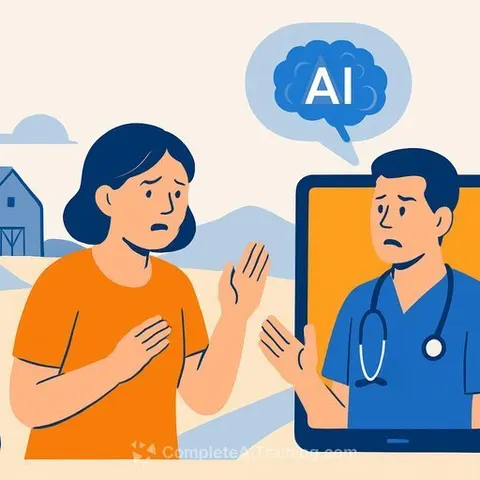
More than 70% of Americans say it's extremely or very important that their doctor disclose when AI is used in their care, according to new Pew Research Center data. Yet nearly half of respondents said they don't know whether AI has ever been used in their own healthcare, and only 22% said they confidently understand how doctors use the technology.
The findings come from two Pew reports published Tuesday, based on surveys of more than 4,000 Americans. They paint a picture of a public that is simultaneously wary of AI in clinical settings and increasingly willing to use AI chatbots for medical advice - more than a third of respondents said they've done so, and nearly all of them called it helpful.
Transparency gap between patients and providers
More than 80% of respondents said they want to know whether their doctor uses AI to analyze scans and make diagnoses. A majority also said they don't believe they have a say in whether their providers use AI, and would like more control.
"Patients have a fundamental right to know when AI touches their care," said Jyoti Pathak, dean of Arizona State University's School of Technology for Public Health. "Broad adoption of healthcare AI requires trust, and trust depends on clear disclosure."
Part of the gap may stem from confusion about what "AI" means in a medical context. The public often associates the term with generative chatbots like ChatGPT, but healthcare AI includes a much wider range of technologies that have been in use for years.
"We have been researching uses of machine learning in medical related practices for decades at this point," said Tim Curry, a public health lecturer at Northern Arizona University. Curry said he has worked with ECG machines equipped with, by today's standard, a basic AI model used to interpret patterns.
"I think most of the world is still catching up with what AI really means, how it is really being used, and what the full impact is," he said. "Especially outside of generative AI."
Chatbots as a stand-in for medical care
Young adults are the most likely age group to use AI chatbots for medical advice, Pew found. That tracks with broader trends: medical costs are rising at historic rates, and young adults have the lowest insurance coverage of any age group.
Most chatbot users said they turned to the tools for free or affordable diagnoses. A smaller share said they used them to learn more about a doctor's diagnosis or better understand lab results.
But the convenience comes with real risks. "Many AI services require users to opt out of having their chats used for training future AI models, meaning your personal health data is now being used to train the next AI advancement," Curry said.
Because open-source tools often lack access to a patient's specific medical history and clinical context, Pathak said chatbots are likely to persuasively misinform users, leading to either false reassurance or unnecessary panic.
Risk varies by use case
Pathak drew a distinction between clinical AI and administrative AI. Diagnostic and treatment algorithms carry the most risk and require "stringent FDA oversight, clinical validation, explicit transparency, and strict clinician review," he said.
Administrative models for scheduling and billing are lower risk and could improve operational efficiency, he added. Both he and Curry said education and consent are necessary across the board.
"These really are not separate things," Curry said. "You would need appointments and testing to obtain the data that an AI model may be trained to help analyze."
Curry suggested that medical practices could eventually build their own AI programs to discuss health information in a more controlled setting, subject to HIPAA privacy rules - unlike open-source models. In the meantime, he recommended that people who can't see a doctor immediately refer to Mayo Clinic, Cleveland Clinic, and other free websites with peer-reviewed information.
Why this matters for healthcare professionals
For clinicians and administrators, the Pew data signals a trust deficit that will shape how AI tools get adopted. Patients want disclosure and control, but most don't understand how AI already works in their care - which means the burden of explanation falls on providers. Practices that develop clear consent processes and distinguish between high-risk clinical AI and low-risk administrative tools will be better positioned as regulators and patients push for transparency. For those working in medical billing and scheduling, AI for Medical Billers offers a practical starting point for understanding where automation fits safely. Broader training on AI for Healthcare can help professionals speak accurately about the technology - and answer the questions patients are increasingly likely to ask.