
AI news ·
NVIDIA Launches Alpamayo-R1, First Vision-Language Action Model for Autonomous Driving, with Cosmos Cookbooks
NVIDIA's Alpamayo-R1 brings visual, language, and action together for safer, clearer driving decisions. Devs get Cosmos Cookbooks for data, synthetic edge cases, and evals.
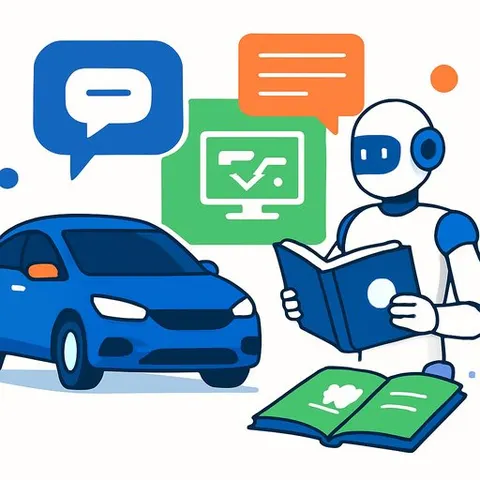
NVIDIA Launches Alpamayo-R1: A Visual-Language-Action Model for Autonomous Driving
NVIDIA introduced Alpamayo-R1, a new AI model built for physical AI devices like robots and autonomous vehicles. Unveiled at the NeurIPS conference, it's positioned as the first visual-language-action (VLA) model focused on autonomous driving.
The core idea: process text and images together so vehicles can "see" the scene, reason about it, and choose actions that feel more natural. It builds on the Cosmos-Readon reasoning model, part of the Cosmos family first released in January 2025.
What stands out for developers
- VLA for driving: Fuses perception (images) with intent/constraints (text) to produce action-level outputs.
- Reasoning-first design: Cosmos-Readon emphasizes thinking through decisions before responding, which matters for edge cases.
- "Healthy" decision-making: The goal is safer, more context-aware driving choices under uncertainty and changing conditions.
Why it matters for AV stacks
- Bridges perception-to-action with a reasoning layer that can explain and justify choices better than pure pattern matching.
- Supports instruction-following (e.g., "prefer slower speed in heavy rain") combined with visual context.
- Better fit for mixed inputs: traffic rules as text, scene understanding from cameras, and potentially other sensors via intermediate representations.
Cosmos Cookbooks: resources to build with
Alongside Alpamayo-R1, NVIDIA released Cosmos Cookbooks: step-by-step resources and a post-training workflow aimed at practical use and fine-tuning.
- Data curation: Guidelines to assemble high-signal datasets for decision-making.
- Synthetic data creation: Recipes for augmenting rare scenarios and edge cases.
- Evaluation: Structured methods to measure decision quality and safety performance.
- Availability: Posted on GitHub and Hugging Face for faster onboarding.
Useful links: NeurIPS and Hugging Face.
How to get started (practical path)
- Define modalities: Start with camera frames and textual constraints; decide how you'll encode additional sensors if needed.
- Curate data: Use the Cookbook guidance to label intentions, interventions, and outcomes that reflect real driving choices.
- Create synthetic edge cases: Weather shifts, occlusions, odd pedestrian paths, confusing signage-generate and balance them.
- Post-train: Follow the provided workflow to align decision policies with your deployment goals (comfort, safety, speed).
- Evaluate tightly: Track off-policy metrics, scenario coverage, near-miss counts, and regression on known tricky scenes.
- Plan integration: Place the VLA in your stack (policy layer or decision support), define fallbacks, and log reasoning traces.
Integration notes
- Latency budget: Benchmark end-to-end time from perception to action selection on your target hardware.
- Safety guardrails: Keep rule-based constraints and hard limits for speed, distance, and no-go actions.
- Human-in-the-loop: For early phases, run Alpamayo-R1 in assist mode with continuous feedback and capture disagreements.
- Simulation first: Validate policies across a large bank of synthetic and recorded scenarios before limited road testing.
What to watch next
- Sensor fusion strategy: How text+image reasoning pairs with LiDAR/radar signals via learned or engineered mid-level features.
- Generalization: Performance under distribution shifts (new cities, lighting, signage standards).
- Tooling maturity: Depth of Cookbook examples, benchmarks, and standardized eval sets for action-level decisions.
If you're building AV systems or robotics pipelines, Alpamayo-R1 plus the Cosmos Cookbooks looks like a direct path to experimentation: clear data guidance, synthetic generation, and a post-training loop to make decisions safer and more natural.
For structured learning paths and upskilling around AI systems by leading companies, explore AI courses by leading companies.