
AI news ·
OpenAI and Anthropic cut prices as Chinese AI rivals gain ground
OpenAI and Anthropic have cut API prices on their flagship models as Chinese rivals like DeepSeek push cheaper open-weight alternatives into the global market. The reductions shift cost competition to the forefront, narrowing the price gap enterprises see between proprietary and open models.
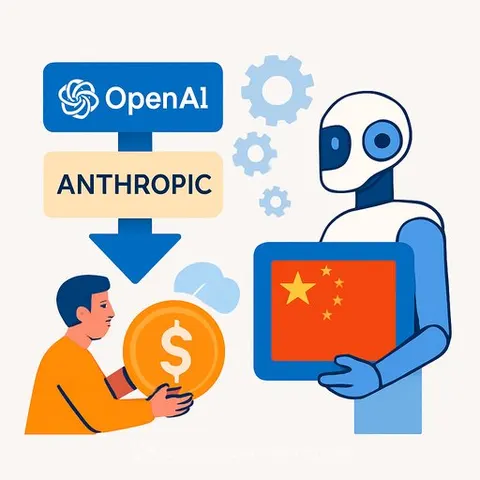
OpenAI and Anthropic are cutting prices on their AI models as Chinese rivals such as DeepSeek, Alibaba, and ByteDance push into the global market with cheaper alternatives. The moves mark a shift from a focus on capability alone to price competition, a development with direct consequences for organisations building AI products at scale.
The price reductions follow months of pressure from Chinese models that have matched US performance benchmarks at a fraction of the cost. DeepSeek's open-weight models, in particular, have forced Western labs to respond on price as enterprises compare total cost of ownership alongside raw capability.
Price cuts across the board
OpenAI has reduced the price of its flagship GPT model for developers, citing improved inference efficiency. Anthropic has made similar adjustments to its Claude family, particularly for batch processing workloads, where the cost per token drops significantly.
The cuts apply mainly to API pricing - the rate developers pay per token for model access - rather than consumer subscriptions. For AI engineers and product teams, this changes the unit economics of building AI features in serious, production use cases.
A byproduct of the open-source push
The competitive threat is the open-source ecosystem many enterprise teams now use by default. Chinese labs lead the delivery of open-weight models that rival proprietary versions in performance on many common tasks.
US labs answer with controlled price cuts and proprietary advances. But the gap between exclusive and open models on price narrows month by month. Enterprises building on open models have less reason to switch, which pushes OpenAI and Anthropic to compete on cost, not just capability.
What the price war means for your roadmap
If your team builds AI applications, this is the moment to revisit your cost assumptions. The API price drops make many previously marginal models viable for high-volume tasks like classification, summarization, and extraction. That renews the business case for projects that struggled with unit costs in the last round of budgeting.
Watch how pricing evolves among third-party model hosts, not just the big labs. If Chinese open-weight rivals keep improving, the market is heading toward lower prices, not a stable oligopoly. Teams that build in multi-model support from day one stay flexible - and cheaper than those tied to one vendor.