
AI news ·
OpenAI brand trip backlash reveals tension between lifestyle marketing and complex technology
OpenAI hosted 30 creators at a $2,000/night resort; the resultant social media backlash focused on monogrammed pyjamas and beekeeping instead of AI tools. Marketers say AI requires a creator strategy built on trust and utility, not luxury aesthetics.
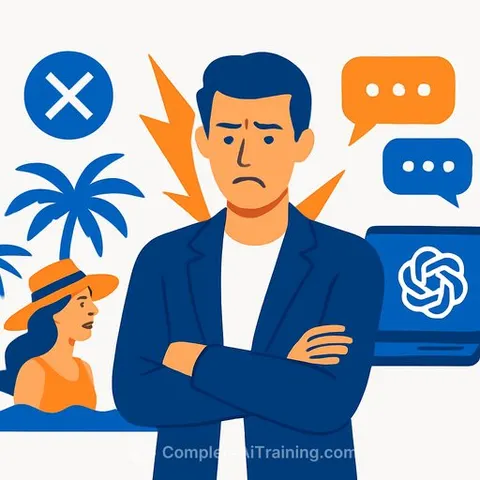
OpenAI hosted roughly 30 creators at Wildflower Farms, a luxury resort in New York's Hudson Valley, for an event creators dubbed "OpenAI Summer Camp." The retreat paired sessions on OpenAI tools with meals, outdoor activities and branded merchandise at a property where rooms can cost upwards of $2,000 a night. But the images that travelled furthest were not of creators experimenting with AI products - they were of monogrammed pyjamas and beekeeping.
The gap between what happened at the retreat and what spread across social media has opened a larger question for the influencer marketing industry: can an AI company borrow the traditional lifestyle brand-trip playbook, or does a technology associated with jobs, copyright, data, energy consumption and sweeping workplace change demand a different kind of creator strategy? The episode also raises a second question: whether creators who can generate mass visibility should be the same people expected to establish credibility for complicated technology.
For marketing executives, the backlash was predictable. "Beauty sells aspiration. AI sells something far more complicated; it touches people's jobs, their data, their sense of what the future looks like for them," said Kalyan Kumar, Co-Founder and CEO of KlugKlug. "You cannot market that shift with a luxury resort and a content brief. The moment you do, you've told the world that you don't understand your own product's implications. AI needs a fundamentally different creator strategy built around trust, education, and honest conversation, not aesthetics."
The packaging overwhelmed the product
Creator and marketer Hannah Zhang offers a counterpoint. Zhang said she turned down the OpenAI brand trip - not because she anticipated the controversy, but because she was already travelling to San Francisco to film a video for ChatGPT Work with OpenAI. She has previously partnered with OpenAI as well as competing AI companies Anthropic and Perplexity. Her own OpenAI association did not generate anything resembling the criticism directed at creators who attended the retreat.
Zhang's conclusion was that the creator economy itself is changing. The traditional formula of an attractive destination, products and abundant social content was developed largely around lifestyle categories. But when the creators involved are marketers, operators, founders and educators, she questioned whether the experience should instead be designed around workshops and creative collaboration.
Ironically, Zhang said, OpenAI's event attempted to do both. The creators themselves were "curious, driven people" who were learning and building during the retreat. The problem was that this was not necessarily the version of the event that travelled outside their audiences. "The luxury was easier to see and easier to react to than the learning happening behind it," she wrote.
Kumar argued that OpenAI "confused the messenger with the message." The creators who attended were genuinely curious and genuinely learning, he said, but the packaging sent a different signal to everyone outside that room. "The content that left that trip was the lavishness, not the learning. That's a briefing failure, not a creator failure."
Brand trips are built to create envy - AI may not want it
Amit Dhawan, Co-Founder at Crack'd, believes the brand-trip model itself is not obsolete. The problem was the match between format and category. "The format isn't broken, the match is," he said. "A brand trip works when the product's promise is leisure, taste or self-transformation, because the setting and the story agree. It fails when the product's controversy is material."
According to Dhawan, luxury can turn a contested technology into a status symbol before the brand has established why audiences should trust it. "Worse, brand trips are engineered to produce envy, and envy pointed at a category people are already anxious about turns into anger very quickly," he said.
Dhawan sees four strategic mistakes in the OpenAI campaign: briefing creators for delight rather than preparing them to engage with difficult questions; showcasing hospitality instead of product proof; choosing a setting that made criticism easy to frame; and leaving individual creators disproportionately exposed once the backlash began. "If the point was teaching creators to use ChatGPT Work, the content should have been the work, and instead the internet saw beekeeping," he said. "The brand had a spokesperson. She had a comment section. Next time the credible creators say no, and that is the real cost of this campaign."
Shudeep Majumdar, Chief Executive Officer and Co-Founder of Zefmo, said AI companies can borrow the accessibility of beauty and fashion marketing, but cannot simply replicate their playbook. "A beauty product asks consumers to desire it. An AI product asks people to trust it, often with their work, data and decisions," he said. The strategy therefore needs aspiration as well as evidence, including creators showing genuine utility while acknowledging questions around employment, privacy, copyright and environmental impact.
Social platforms make that distinction more important. "Images of an expensive resort or monogrammed pyjamas will travel faster than footage of a workshop," Majumdar said. "The campaign needed to lead with what creators learned, built, tested or challenged."
Anirudh Sridharan, Co-Founder of HashFame, draws a line between luxury marketing and lifestyle marketing itself. "We've confused lifestyle with luxury. They're not the same. Luxury is about consumption. Lifestyle is about identity," he said. AI can become a lifestyle product, in his view, but the content has to demonstrate the identity and capability enabled by the technology. "When you're introducing a technology that reshapes work, every piece of content has to answer one question: 'How does this make me more capable?' They answered, 'Look where we stayed'."
His prescription is not to abandon lifestyle creators altogether, but to sequence the strategy differently. "Practitioners create belief. Lifestyle creators normalize behavior. Every new category follows the same curve: credibility first, culture second. The mistake is trying to skip the first step."
Vishal Prabhu, Creative Director - Strategy at White Rivers Media, said the choice should not be reduced to reach versus expertise. Lifestyle creators can make AI feel accessible outside technology circles, while practitioners and educators can demonstrate how products function in real workflows and explain both strengths and limitations. "Reach creates curiosity. Credibility creates confidence," he said.
Why this matters for marketers
The OpenAI retreat is a case study in format mismatch. For marketers planning creator campaigns around AI products, the lesson is not to abandon influencer marketing - it is to lead with practitioners, operators and educators who can demonstrate real utility, and to use lifestyle creators only after credibility is established. Krishna Desai, Chief Product Officer and Data Scientist at Animeta, said developers, founders, designers and productivity specialists should form the first layer of an AI creator strategy, showing how tools integrate into actual work. If lifestyle creators are used, the product needs to stay at the centre of the story, whether that means showing how AI helps organise a schedule, plan meals or solve everyday problems.
The cost of getting this wrong is not just a bad press cycle. As Dhawan put it, the credible creators may simply say no next time. For marketers, that means the difference between a campaign that generates awareness and one that generates trust - and for AI products, trust is the adoption barrier that matters most. Understanding how OpenAI's tools work and how they fit into real workflows is a starting point for any marketer planning such campaigns; OpenAI Courses can help bridge that knowledge gap. Similarly, knowing how Social Media dynamics shape public perception of AI brands is essential for avoiding the kind of backlash that turned a learning event into a meme.