
AI news ·
Real Madrid turns to Adobe AI to bring 660 million fans closer
Real Madrid and Adobe are wiring generative AI into content to serve 660M fans with local, context-aware stories. It's a playbook for scale, speed, and staying relevant in markets.
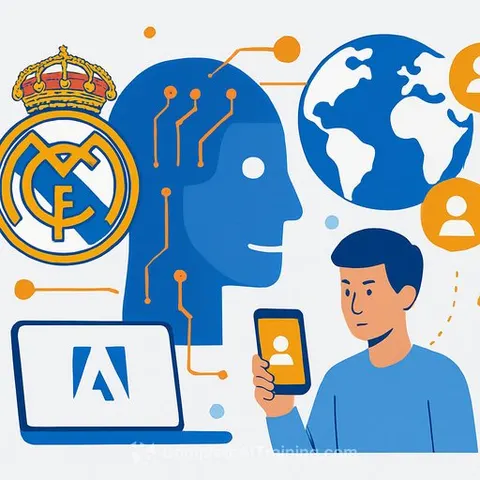
Real Madrid x Adobe: The AI content play creatives should pay attention to
Real Madrid just deepened their partnership with Adobe and plugged generative AI into their content engine. The goal: produce localized, context-aware assets for a claimed 660 million fans - at a scale no European club has shown publicly.
This isn't a flashy press line. It's a shift in how content gets made, versioned, and shipped. The club wants relevance in every market, not just reach.
What Madrid's move signals
- Scale with taste: mass content that still feels close to the end viewer.
- Speed-to-story: less waiting on edits, more real-time creative cycles.
- Beyond match clips: player stories, community angles, culture-first pieces.
- Agentic workflows: AI that takes tasks from brief to draft to versioning.
As Emilio Butragueño put it, the aim is a deeper connection with fans "wherever they are." Adobe's Rachel Thornton framed it simply: football's pull "extends beyond match action." If you make content for living, this is your signal to systematize.
A likely workflow under the hood
- Signals in: audience data, language, region, sentiment, match context.
- Brief generator: AI creates creative briefs and messaging angles.
- Asset graph: templates, footage, graphics, brand tokens, voice rules.
- Generation: copy, short-form video, carousels, thumbnails, captions.
- Localisation: micro-variants by dialect, slang, cultural cues, offers.
- Guardrails: automated checks for voice, legality, names, sensitive topics.
- Distribution: timed drops per market and platform behavior.
- Feedback loop: performance informs the next brief automatically.
Steal this for your team
- Build modular templates: headlines, CTAs, lower thirds, colorways, intro hooks. Make them swappable.
- Create a style "dictionary": voice do/don't, brand analogies, tone sliders (playful ↔ formal), taboo terms.
- Use prompt boards: 20 reusable prompts per format (email, reel, carousel, caption). Keep them versioned.
- Localize with micro-variants: change slang, cultural references, offers, and visual cues - not just language.
- Automate QA: name spellings, sponsor rules, compliance checks, profanity filters before anything ships.
- Set provenance: track what's AI-made and what's edited. If relevant, add content credentials like C2PA.
Metrics that matter (and actually move revenue)
- Depth: completion rate, rewatches, saves, shares, repeat sessions.
- Context fit: uplift by market, language, and platform surface.
- Creative ops: time-to-first-draft, review cycles, rework rate.
- Commercial: click-through to merch, sign-ups, ARPU, LTV vs CAC.
Risk and guardrails
- Hallucinations and factual slips: lock entity lists (names, dates, stats) and require human approvals.
- Bias and cultural misses: include local reviewers and red-team sensitive topics.
- Brand drift: enforce tone rules and visual tokens at generation time.
- Licensing: trace media rights; watermark or label synthetic elements when needed.
- Privacy: keep PII out of prompts and logs; use role-based access for datasets.
30-day sprint to build your own "AI content line"
- Week 1: Inventory assets, define 3 priority formats, write guardrails, pick success metrics.
- Week 2: Build templates and prompt packs. Set up automated QA checks.
- Week 3: Pilot in one market and one platform. A/B five micro-variants per post.
- Week 4: Review data, tighten prompts, roll to 3 more markets. Document the playbook.
Tools worth exploring
- Adobe's generative suite for images, video, and text variants: adobe.com/sensei/generative-ai
- If you want structured learning and prompt systems for creative teams: AI courses by job and AI tools for copywriting
Why this matters for creatives
Content is shifting from one-off campaigns to living systems. Madrid is treating every story as a product with versions, tests, and local context.
That's the lesson. Build the system, then let AI handle the repeatable parts while you chase the angles only a human would see.
Bottom line: dominance isn't just who you sign - it's the data and workflows you feed your creative machine. The teams that ship faster, test smarter, and stay human in their decisions will win attention and keep it.