
AI news ·
Report finds low-quality AI ads harm brand perception
A study of 22,000 consumers found 42% say low-quality AI ads damage brand perception. Meanwhile, 40% responded positively to professional AI advertising.
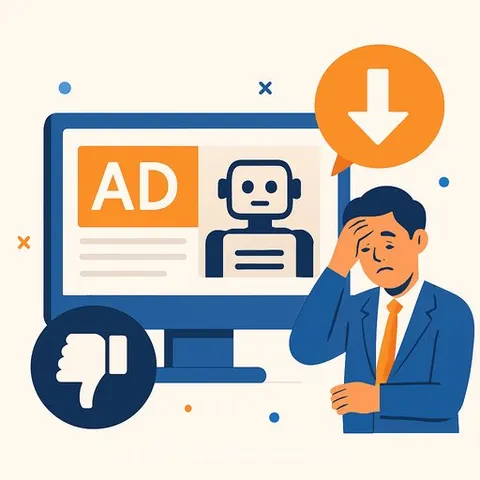
Poorly executed AI-generated advertising directly harms brand perception, according to a new global study from DoubleVerify. The survey of 22,000 consumers across 22 markets found that 42% of respondents said low-quality or unrealistic AI-generated advertising would negatively affect their opinion of a brand, while professionally produced AI advertising earned a positive response from 40%.
Consumers prioritize quality over technology
The report, "Global Insights: Media Quality in the Age of AI," also surveyed 2,020 marketers and advertisers in 21 markets. It reveals that consumers' attitudes toward AI are shaped less by the technology itself and more by the quality and context of its use. Globally, 63% of consumers believe AI-powered tools-such as search summaries, chatbots, and creative automation-improve their online experience. That figure drops to 50% in North America, the lowest of any region.
However, 56% of consumers cannot consistently identify AI-generated content. This ambiguity makes the stakes higher for brands: if the output is perceived as low-quality, the damage is real. The 42% who said bad AI ads would hurt their brand opinion is a warning signal for marketers who rush to deploy generative AI without sufficient quality control.
AI chat advertising depends on context
Advertising within AI chat platforms receives a mixed response. Globally, 46% of consumers view it positively, while in North America only 34% share that sentiment. The study tested multiple scenarios and found that contextual relevance was the only situation where positive sentiment outweighed negative. When ads matched the surrounding content, consumers were more accepting. This suggests that simply inserting ads into AI chat interfaces will not work-placement must be thoughtful and relevant.
Marketers share consumer concerns
Marketers are far from complacent. More than half (53%) worry about their ads appearing alongside low-quality AI-generated content, and 45% expressed concern even about placement next to high-quality AI content. Nearly half (48%) are uneasy about using AI to create advertising assets, with concern rising to 63% among North American respondents. Half of marketers also feel uneasy about advertising within AI platforms in general, jumping to 63% in North America.
The report indicates that marketers considering AI chat as an advertising channel want greater transparency and independent measurement before they increase investment. They are not rejecting AI outright, but they are demanding the same confidence and clarity they expect in other digital channels.
Regional optimism varies
Attitudes toward AI in advertising are not uniform across the globe. The study found stronger optimism in Latin America and Asia-Pacific:
- 69% of consumers in Latin America and 68% in Asia-Pacific said AI-generated content improved their online experience.
- 57% in Latin America and 53% in Asia-Pacific viewed advertising in AI platforms positively.
- In EMEA, 53% said AI content improved their experience, while 39% viewed AI platform ads positively.
Mark Zagorski, CEO of DoubleVerify, said: "AI is rapidly reshaping how content is created, how consumers experience media and how advertisers reach audiences. Our research confirms that AI itself is not what determines engagement. The quality of the output does. As AI becomes more deeply embedded across the digital ecosystem, the industry must ensure that innovation does not come at the expense of media quality, transparency or trust. Advertisers need the same confidence and clarity in emerging AI environments that they expect across every other digital channel."
Why this matters for marketing professionals
This study dispels the notion that AI alone is a magic bullet for advertising. The data shows that consumers are quick to penalize brands for low-quality AI-generated content, but they are receptive when the output is polished and contextually relevant. For marketing teams, this means rigorous quality control and contextual targeting are non-negotiable. As AI becomes more integrated into ad creation and placement, brand managers and marketing professionals need to stay informed about best practices. Training such as the AI for Brand Managers learning path can help brand leaders understand how to protect brand equity in this new environment. Similarly, broader education on AI for Marketing equips professionals with the skills to evaluate and deploy AI tools without damaging consumer trust.