
AI news ·
Revolutionizing Dermatology Education: Harnessing GPT-4 for High-Quality Synthetic Clinical Vignettes
GPT-4 generates accurate, comprehensive dermatology vignettes, enhancing medical education with scalable, customizable learning resources. Improved demographic diversity is needed.
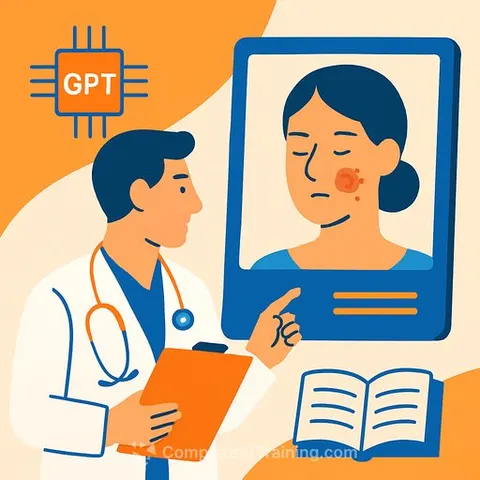
Synthetic Medical Education in Dermatology Using Generative AI
The rise of large language models (LLMs) offers a new approach to medical education. By generating synthetic content, LLMs can provide virtually unlimited learning resources for medical trainees. This article reviews a study that used OpenAI's GPT-4 to create clinical vignettes and explanations for 20 skin and soft tissue diseases relevant to the United States Medical Licensing Examination (USMLE).
Key Findings
- Physician experts rated the generated vignettes highly for scientific accuracy (4.45/5), comprehensiveness (4.3/5), and overall quality (4.28/5).
- Potential clinical harm and demographic bias received low scores (1.6/5 and 1.52/5, respectively), indicating safe and balanced content.
- A strong correlation (r = 0.83) was found between comprehensiveness and overall quality, emphasizing the importance of detailed clinical scenarios.
- The vignettes lacked significant demographic diversity, highlighting a need for more inclusive content.
Why This Matters
Medical education depends heavily on clinical vignettes to assess diagnostic reasoning and management skills. Traditionally, creating these vignettes requires significant time and expertise, limiting their availability. LLMs like GPT-4 can generate diverse case scenarios quickly, potentially democratizing access to quality educational materials.
For dermatology, where visual and textual descriptions of skin conditions are essential, LLM-generated vignettes provide a valuable text-based learning supplement. They can be customized on demand, adapting to individual learner needs as questions evolve.
Details of the Generated Vignettes
- 20 skin and soft tissue diseases were randomly selected from the USMLE content outline.
- Patient demographics in the vignettes skewed toward males (15 males, 5 females) with a median age of 25 years.
- Race was mentioned in only 4 cases, indicating limited demographic variety.
- Average vignette length was about 146 words, which aligns well with the USMLE question format.
- Explanations accompanying vignettes averaged 185 words, offering detailed educational context.
Evaluation by Experts
Three attending physicians, including a dermatologist and specialists in internal and emergency medicine, rated the vignettes. Their assessments confirmed that GPT-4 generated clinically accurate and comprehensive cases with minimal clinical risk or bias. However, the limited demographic range suggests a need for more inclusive prompt design and training data.
Challenges and Limitations
- Demographic diversity was limited, which may reduce applicability to varied patient populations.
- Potential AI hallucinations—incorrect or fabricated information—pose a risk, requiring expert review before clinical use.
- The evaluation panel was small and included only one dermatologist, which might affect the sensitivity to subtle dermatologic nuances.
- LLMs are trained on broad data sources that may not always reflect current standards of care.
Implications for Medical Education
The ability of GPT-4 to generate high-quality clinical vignettes shows promise for expanding educational resources in dermatology and beyond. Synthetic education could reduce reliance on limited question banks and faculty time, making learning materials more accessible and customizable.
Still, careful validation by clinical experts remains essential to ensure accuracy and fairness. Incorporating prompts that encourage demographic diversity will improve relevance for all patient groups.
How the Study Was Conducted
- 20 skin-related conditions from the USMLE Skin & Subcutaneous Tissue section were selected.
- GPT-4 generated clinical vignettes and explanations on November 14, 2023, using new chat sessions for each prompt.
- Three physicians rated vignettes on scientific accuracy, potential harm, comprehensiveness, bias, and overall quality using a Likert scale.
- Statistical analyses included correlation assessments between evaluation criteria.
This study received IRB exemption since it did not involve patient data or human subjects.
Conclusion
LLMs like GPT-4 can produce clinically accurate and comprehensive dermatology vignettes suitable for medical education. They present a scalable and accessible solution to the resource constraints of traditional question development. Efforts to improve demographic representation and ongoing expert oversight will be important to maximize their educational value.
For healthcare professionals interested in integrating AI into medical education or clinical practice, exploring courses on AI and prompt engineering can provide practical skills. Platforms like Complete AI Training offer relevant resources to get started.