
AI news ·
Russian and Chinese AI tools spread Ukraine fatigue narratives across Europe, report finds
As US aid to Ukraine fell 99% in 2025, Russia's Storm-1516 network shifted to attacking European backers, publishing 34 false claims that drew 274 million views. The propaganda failed in Hungary's 2026 election, where voters rejected Orbán, proving credible counter-speech beats regulation.
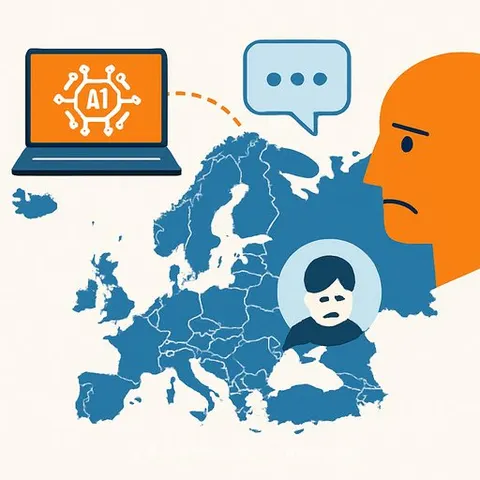
When US military aid to Ukraine fell by 99% in 2025 and Europe stepped in to fill the gap, Russia's influence machinery changed targets. Storm-1516, a network linked to the Internet Research Agency, shifted from undermining American support to attacking the Europeans now footing the bill - Germany, suddenly Ukraine's largest military donor at €9bn, and France, whose president had emerged as one of Kyiv's leading champions.
According to a February 2026 NewsGuard investigation, Storm-1516 has published 34 false claims aimed at the two countries since January 2025, generating 274 million views. The core message: Ukraine is bankrupting Europe, exhausting its citizens, and dragging the continent toward war.
Russia no longer operates alone. Moscow and Beijing have deepened coordination on artificial intelligence governance, digital standards, and media policy. OpenAI's October 2025 threat report found Russian-linked actors using the Chinese AI model DeepSeek to conduct influence campaigns, while independent analysis showed Chinese AI models embed content controls that reproduce Kremlin narratives on Ukraine. The European Commission's 2025 report on foreign information manipulation concluded that Russian and Chinese actors have "fully implemented AI tools" for such operations.
The regulatory gaps that let propaganda through
The Russian-Chinese propaganda offensive skirts around European regulation. Since X is designated as a very large online platform under the EU's Digital Services Act, it must take measures to identify and block Storm-1516's propaganda. European regulators fined the platform €120 million in December 2025 for breaching DSA transparency obligations; a month later, the Commission extended its investigation into X's recommender systems.
But the same narratives migrate within hours to the Telegram messaging service, which is not designated as a very large online platform, has not signed the EU's Code of Practice on Disinformation, and offers no system for reporting disinformation. Ukraine's Centre for Democracy and Rule of Law found that sanctioned Russian propaganda channels on Telegram are blocked only partially - some not at all - while duplicate channels carrying identical content operate freely under altered names.
Another gap runs across the Atlantic Ocean. Europe's DSA applies to platforms operating in the EU, but US-hosted services face no equivalent obligations. The current US administration has widened the gap by rolling back AI safety commitments and framing European digital regulation as protectionist. A Ukraine fatigue narrative manufactured in Moscow can move through US-based channels that owe nothing to the DSA and resurface in European media looking like organic public opinion.
A final gap - and the least discussed - runs along the EU's own borders. Candidate countries in the Western Balkans have no obligation to implement the DSA and have limited capacity to monitor AI-generated content. Here, Ukraine fatigue does double duty: the same messaging that tells French and German voters their governments are wasting money on Kyiv gets repackaged for Balkan audiences as evidence that the EU cannot sustain its commitments - so why trust its promises on enlargement? As the London-based Institute for Strategic Dialogue and CIDOB, the Barcelona Centre for International Affairs, have documented, anti-enlargement narratives from Russian and Chinese-affiliated outlets circulate freely in Serbian, Bosnian, and Montenegrin media.
What happened when the machine met Hungarian voters
These three gaps converged during Hungary's April 2026 elections. The ruling Fidesz party ran a campaign built on Ukraine fatigue, reinforced by AI-generated imagery, deploying synthetic news anchors and deepfake endorsements on TikTok and content on X and Telegram.
But the propaganda failed. Hungarian voters saw through the lies and rejected Viktor Orbán in a historic landslide: Péter Magyar's Tisza Party won 141 out of 199 seats, ending 16 years of Fidesz rule. Despite the AI-generated content, the bot networks, and the coordinated foreign campaigns, a mobilized electorate proved more powerful than the narrative machine.
Hungary's lesson is important: The most effective counter to AI-powered propaganda is not better regulation - it is better democratic speech. Credible counternarratives from independent media, fact-checkers, and political leaders willing to make the case for Ukraine in plain language did more to defeat Fidesz's narrative machine than any platform rule.
Regulation still has a role, but a more modest one than Europe's policymakers like to admit. Bringing Telegram under meaningful DSA obligations, enforcing the AI Act's transparency rules, and helping Western Balkan candidate countries build media literacy and fact-checking capacity can narrow the gaps that adversaries exploit. But the DSA's record - two fines in over two years - is a reminder that rules on paper mean little without the will to apply them. What defeated the propaganda in Hungary was not an algorithm or a regulation. It was citizens who refused to believe the lies.
Why this matters for operations professionals
For anyone running operations in Europe - whether in logistics, finance, or public sector delivery - this is not an abstract geopolitical story. AI-generated disinformation targeting European support for Ukraine is designed to disrupt supply chains, delay procurement decisions, and create political instability that ripples into contract awards, border procedures, and energy pricing. The Hungarian election shows that narrative attacks can be defeated, but only with fast, credible counter-speech. That means building verification workflows into how your team consumes intelligence, monitoring Telegram and X for narratives that could affect your suppliers or routes, and treating media literacy as an operational skill, not a communications department concern.