
AI news ·
Small businesses and creatives push back against AI-generated content
A Queensland sewing business owner received nearly 30 inquiries in days after offering hand-drawn posters for $5 or free, pushing back against AI-generated imagery. A nearby wine bar also banned AI from its output after learning the tools train on copyrighted material.
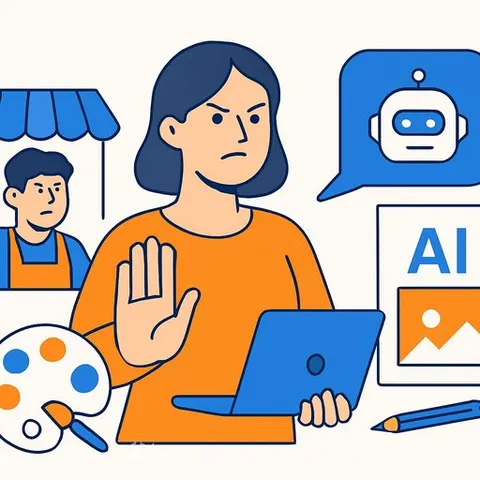
Chloe Young scrolls through social media and sees the same thing over and over: images generated by artificial intelligence. The 28-year-old creative, who runs an online sewing and garment-making business in Toowoomba, calls the feeds "hollow," "soulless," and "homogeneous." Young decided to push back by offering hand-drawn posters to small businesses and community groups for a small fee, or free if they could not pay.
"I just got so frustrated with everything and everyone that I said, like, 'Hey, I will literally do anything for $5 or free,'" Young said.
Within days, nearly 30 inquiries arrived from people seeking alternatives to AI-generated content. Young is not a graphic designer, but the response signals a growing appetite among some consumers and business owners for work made by humans. The pushback comes as governments fast-track data centre applications and tech giants pour billions into generative AI tools that produce text, music, video, and imagery at little to no cost for users.
A wine bar's AI policy shift
A few streets from Young's studio, Taylor Hailes was preparing to open The Book Pour, a boutique wine bar and bookshop. In the rush before launch, she turned to AI for flyers and social media posts. "When you're in a small business, and you're trying to do everything at once, you naturally turn to tools that can help you out," she said.
Then an author called. The writer had recently withdrawn from another event over its use of AI and wanted to know about The Book Pour's AI policy. Hailes said the conversation made her realize she did not fully understand how generative AI works or the risks it posed to creative industries. She had not known these systems are trained on material already available online, including copyrighted works.
"I could totally see where they were coming from and why they wanted to protect the creative arts sector," Hailes said. Her business posted an apology on Instagram and introduced a formal AI policy: no AI in author works, no AI in artwork, and no AI in the shop's own output.
"We made sure our community knew what had happened, what had been brought to our attention and what we were going to do about it," she said. "We had a really great response."
Consumer wariness grows
Park Thaichon, an associate professor of marketing at the University of Southern Queensland, said the concerns reflect a broader shift. While AI offers a cost-effective and time-efficient way to create content, some people find the output "too boring, and there's nothing new or outside the box at all."
Thaichon said consumers become particularly wary when businesses use AI-generated images of people or fail to disclose their use of the technology. "This type of thing can lead to misunderstanding, and people will lose trust," he said.
Young said the heavy adoption of AI overlooks what could become a less-human future. "We don't see the problem until it's problematic," they said. "I know someone can look at my posters and be like 'wow, squiggles,' but at least I know that AI didn't make that."
Why this matters for creatives
The responses from Young and Hailes show that small-scale pushback can create tangible business opportunities and community goodwill. For creatives, the signal is clear: a segment of the market actively seeks human-made work and will pay for it, even from someone who is not a trained graphic designer. Understanding how generative AI is trained and being transparent about its use-or deliberate non-use-is becoming a differentiator. Creatives who want to build skills around these tools, whether to use them ethically or to counter them effectively, can explore AI for Creatives Courses and Generative Art Courses to make informed decisions about where AI fits in their workflow.