
AI news ·
South Korea plans round-the-clock AI assistants for public services
South Korea will launch 24-hour AI public services for welfare, taxes, safety, and more by end of 2026, with mandatory AI training for all civil servants. The plan targets 20,000 advanced AI specialists by 2030 and deploys the "On AI" system across 47 agencies by December.
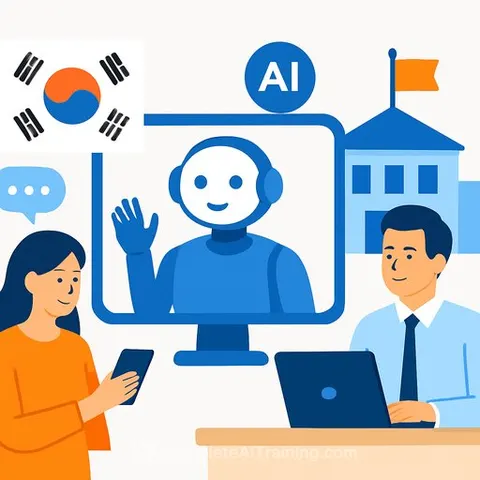
South Korea will offer round-the-clock AI assistance for public services covering welfare, taxes, safety, agriculture, and food and drug information, part of a government-wide push to embed artificial intelligence into daily administrative operations. The plan, presented at a Cabinet meeting Tuesday, also calls for AI to support civil servants in tasks ranging from legal review and report drafting to building permit processing and weather forecasting.
"We aim to make the services available to the public by the end of next year," Jo Won-gab, director of the AI Government Policy Bureau at the Ministry of the Interior and Safety, told The Korea Herald.
The initiative is part of what the Interior Ministry calls an "AI-powered democratic government." The stated goal is not just administrative efficiency but broader public access to government services and participation in policymaking.
What the 24-hour AI service covers
Residents will be able to get AI-powered assistance on care programs, tax payments, infectious disease prevention, and food-related information. The government also plans to consolidate disaster and safety data through the National Safety 24 portal, which will provide services in 22 languages, with AI analyzing individual risk factors and issuing advance warnings on severe weather.
For government employees, the strategy includes AI support for reviewing medicines, processing building permits, assisting police officers in the field, and drafting procurement documents. An AI-powered work management system called "On AI" is scheduled to be introduced across 47 central government agencies by December.
Training and adoption targets
AI training will become mandatory for all civil servants. The government plans to train 20,000 public officials as advanced AI specialists by 2030 - roughly 2 percent of employees across government agencies and public institutions. An annual competition will showcase civil servants' use of AI in their work.
AI will also extend into social services, including healthcare support for seniors and personalized information for young people on job-seeking allowances and startup training. Government officials involved in implementing these systems may find the AI Learning Path for Policy Makers useful for structuring training efforts.
"The essence of an AI-powered democratic government lies not simply in adopting AI technology, but in using it to achieve popular sovereignty by placing citizens at the center of state affairs," Interior Minister Yun Ho-jung said. "We will deliver tangible changes and results that people can experience in their daily lives."
Why this matters for government professionals
The timeline is concrete: public-facing AI services by the end of next year, the "On AI" system across 47 agencies by December, and mandatory AI training for all civil servants. For government employees, this means AI will shift from optional experimentation to required workflow within roughly 12 months. Agencies that begin mapping their specific processes - permit reviews, document drafting, public inquiries - against AI capabilities now will have a material advantage when the systems go live. The 20,000-person specialist training target also signals that deep AI expertise will become a distinct career track within the public sector, not just a general expectation. For those in government roles, the practical takeaway is to identify which of your current tasks fall within the five service areas named in the plan and start testing AI tools on those workflows today. Resources like AI for Government can help with that preparation.