
AI news ·
Students receive 12 periods of AI education per year under new ministry framework
Vietnam now mandates 12 periods of AI education per academic year for all students, per Decision 2422/QD-BGDDT. The curriculum spans primary through upper secondary, covering ethics, techniques, and system design to build workforce-ready AI literacy.
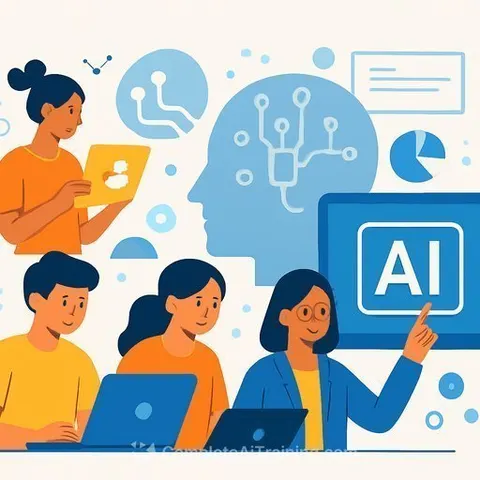
Vietnam's Ministry of Education and Training has issued a new framework requiring all school students to receive 12 periods of AI education per academic year. The policy, formalized in Decision 2422/QD-BGDDT dated August 18, is designed to build AI competencies from primary school through upper secondary level, preparing students for a workforce increasingly shaped by automation and digital tools.
The framework organizes AI education around four competency areas: human-centred thinking, AI ethics, AI techniques and applications, and AI system design. The first two areas serve as guiding principles to ensure AI is used "safely, responsibly and in line with ethical and legal requirements," according to the ministry.
What students will learn at each level
At the primary level, students will explore simple AI applications and learn how AI appears in daily life, alongside lessons on personal data protection and copyright. Lower secondary students will move to using AI tools to create digital products and address learning-related problems, while studying basic AI principles and citizens' responsibilities in a digital society.
Upper secondary students will be encouraged to explore, design, and improve simple AI tools through projects. The goal at this stage is to develop problem-solving and creative skills while exposing students to potential careers in AI-related fields.
The learning process progresses by age: observation and hands-on experience at primary level, exploration and verification at lower secondary, and analysis, critical evaluation, and solution development at upper secondary.
How the programme will be delivered
The core content, designed to ensure essential learning outcomes for all students, will be delivered through AI education topics within the existing Informatics curriculum. Schools will incorporate these topics into their education plans and two-session-per-day teaching schedules "in ways suited to students' characteristics and schools' conditions, without creating excessive pressure or workload."
AI content may also be integrated into other subjects and educational activities to reinforce knowledge and skills, without changing those subjects' required learning outcomes. Extended content beyond the 12-period core can include clubs, projects, experiential activities, extracurricular programmes, and research, depending on student needs and school capacity.
Teaching methods will emphasize experience, practice, problem-solving, and age-appropriate project-based learning. Ethical issues, potential risks, and responsibility in AI use will be addressed through discussions, debates, role-playing, and case studies.
The framework builds on the informatics skills and computer science knowledge already in the current curriculum, and aligns with the competencies set out in Vietnam's 2018 General Education Programme. For HR professionals tracking regional talent pipelines, this means Vietnamese graduates will enter the workforce with structured AI literacy earlier than most global peers. The focus on AI for Education at the national level signals that employers can expect entry-level candidates who understand AI's capabilities and limitations, not just how to use specific tools.
Why this matters for HR professionals
For HR teams recruiting in Vietnam or across Southeast Asia, this framework changes the baseline of candidate skills. Students who complete this programme will arrive with hands-on experience using AI tools and a working understanding of AI ethics and data protection - areas that currently require significant on-the-job training for many new hires.
The policy also signals where the Vietnamese government is directing its education investment, which may affect where multinational companies choose to locate talent hubs. HR departments should review their graduate recruitment criteria and onboarding programmes to account for candidates who have already received structured AI education, and consider how AI for Teachers training might help bridge gaps where school-level instruction is still developing.