
AI news ·
Survey finds bipartisan support in Minnesota for regulating artificial intelligence
A new survey finds 80% of Minnesota adults support a federal agency to regulate AI. Voters also back mandatory testing and deepfake labels.
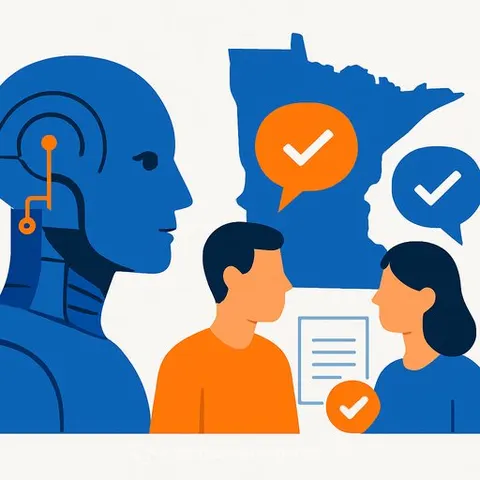
A new survey from the Program for Public Consultation (PPC) released Thursday shows large bipartisan majorities in Minnesota support federal regulation of artificial intelligence. The findings, part of the "Common Ground in the Battlegrounds?" project, come as Congress considers multiple AI bills and signal broad voter appetite for government action. Full results are available on the project page.
Federal agency for AI oversight
Eighty-six percent of Democrats and 75% of Republicans favored creating a new federal agency to monitor AI programs, anticipate problems, define best practices, make policy recommendations, and enforce regulations. Overall support stood at 80% among Minnesota adults. Similar bipartisan majorities appeared in all competitive states and districts surveyed, as well as nationally. For government professionals tasked with implementing such oversight, AI for Government Courses offer practical guidance.
Testing and auditing high-stakes AI
Two proposals aimed at AI programs making decisions that significantly impact people-such as health insurance claims, loan applications, or hiring-also drew strong support. Eighty-six percent of Democrats and 80% of Republicans favored requiring new AI programs to pass a government-designed test before deployment. For AI already in use, 77% of Democrats and 74% of Republicans supported giving the government authority to audit those systems. Both measures received majority backing in every battleground state and district surveyed.
Deepfake labels and campaign ad bans
On deepfakes, 87% of Democrats and 86% of Republicans agreed that any publicly distributed AI-generated image or video must carry a label stating it is not real. A separate proposal to prohibit political campaigns and PACs from using deepfakes in advertisements was favored by 83% of Democrats and 76% of Republicans. National and battleground results mirrored these numbers.
International cooperation on AI and autonomous weapons
Bipartisan majorities also backed U.S. participation in international treaties. Eighty-three percent of Democrats and 75% of Republicans supported creating a treaty to regulate large-scale AI programs. On autonomous weapons, 85% of Democrats and 80% of Republicans favored a treaty banning AI-powered weapons that can fire without direct human command.
Steven Kull, Director of PPC, said, "We're surveying to determine how much common ground there is in Minnesota, and other battleground states and districts. In this first survey, it is clear there is broad agreement among Democrats and Republicans that the federal government should play an active role in regulating artificial intelligence." For those shaping these policies, the AI Learning Path for Policy Makers provides targeted training.
Why this matters for government professionals
The survey results offer a clear mandate for action. With large bipartisan majorities supporting specific regulatory measures, policymakers at both the state and federal level have a strong foundation to advance legislation. Understanding the nuances of these proposals-and the public's expectations-will be critical for government employees involved in drafting, implementing, or enforcing AI rules. The consistent support across party lines suggests that AI regulation is not a partisan issue but a practical one, and professionals who build expertise now will be better positioned to shape the coming framework.