
AI news ·
Taylor Swift registers her voice as a trademark amid growing artist concerns over AI
Anthropic settled one AI copyright suit for $1.5 billion with authors, but the legal fight is far from over. EU law requires permission or a valid exception to train on copyrighted work, and a French bill now aims to flip the burden of proof onto AI developers.
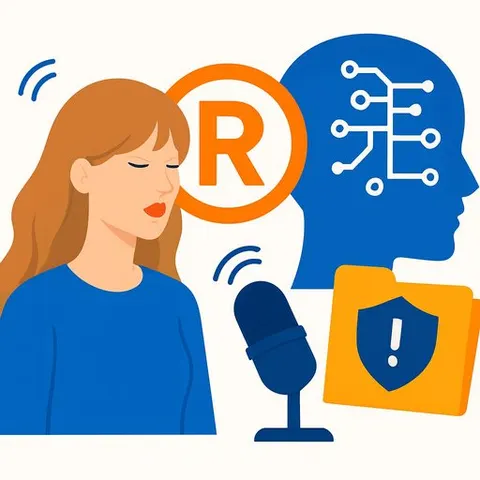
Generative AI companies are training models on vast databases of copyrighted work - books, illustrations, voice recordings - without paying royalties. In the United States, multiple class-action lawsuits are underway. Anthropic already settled one case out of court for $1.5 billion with a group of authors. For rights holders across Europe, the question is whether existing laws are enough or whether enforcement needs to shift.
Eleonora Rosati, a professor of intellectual property law at Stockholm University and of counsel at Bird & Bird, addressed the issue before a keynote at the Digital Rights and Culture Congress in Madrid. She said one principle remains unchanged even as the technology accelerates.
"Intellectual property rights are preventative in nature," Rosati said. "If you want to use a resource to train your AI, you either need permission from the rights holders, or you can rely on an exception that allows you to bypass such consent."
The reproduction question and the limits of fair use
The EU's Artificial Intelligence Act sets transparency obligations for what data trains a model. The United Kingdom has no comparable rules and is still weighing whether to impose them. France is moving in a different direction: a bill would introduce a presumption that a rights holder's content was used for training, flipping the burden of proof onto the AI developer.
Rosati pointed to the technical mechanics that separate a person reading a library from a machine ingesting it. "Technically, AI models perform acts of reproduction that are reserved for copyright holders. That's why I wouldn't say it's possible to draw a perfect analogy to reading."
In the U.S., the fair use doctrine has run into a hard limit. A judge in Bartz v. Anthropic did not question an AI system's ability to read human cultural output. But he noted that some of the documents came from pirate websites. That finding pushed Anthropic to settle. Rosati said the position from U.S. courts and the Copyright Office is clear: "If you use shadow libraries and the like, fair use won't apply."
The same logic is spreading. If illegally sourced content poisons the training process, the entire model's legal footing weakens. "You have an obligation to verify the source of available content," Rosati said.
Voice, image, and the push to register identity
Text is not the only front. Artists and performers are already moving to protect what AI can copy. "Some celebrities are considering how to protect themselves: they've been registering trademarks for the sound of their voice, as Taylor Swift and Matthew McConaughey have done," Rosati said. Multiple regimes - personality rights, performers' rights, GDPR, image rights, and unfair competition law - can all come into play. Denmark has proposed a new digital right of reply.
Rosati said the EU is watching a case referred from Hungary to the Court of Justice. A decision is expected next year and will set the tone for member states on liability for AI-generated outputs and the interpretation of text-mining exceptions.
Why this matters for legal professionals
The next decade of IP litigation will turn on two questions: how courts interpret the text-mining exceptions introduced into EU law, and whether the French model - placing the burden of proof on the AI developer - gains traction at the European level. "Some suggest that it should be introduced in the context of a possible revision of the 2004 Intellectual Property Rights Enforcement Directive," Rosati said. That would require finding common ground among member states and proving an internal market problem.
For lawyers advising creators, publishers, or AI developers, the immediate task is source verification. The longer-term risk is a fragmented legal landscape where the U.S., EU, Japan, and China compete on rules rather than converging on minimum safeguards. Rosati's warning is practical: "We shouldn't adopt laws that are too technologically specific, because they'll become obsolete very quickly." The laws that survive will be the ones built on open concepts - and enforced case by case.