
AI news ·
TechCrunch reporter creates an AI avatar trained on her own journalism
Synthesia used a $4 billion AI avatar startup's tech to create an interactive digital twin of a journalist, trained to discuss only one reported story. The company crossed $100 million in annual recurring revenue last year, but the deterministic avatar cannot replace human judgment or trust.
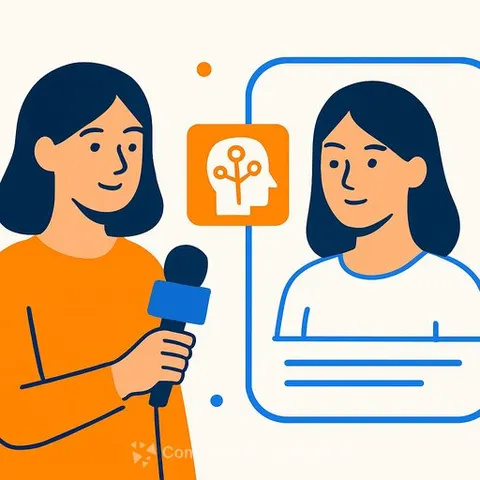
Synthesia, the U.K.-based AI avatar startup valued at $4 billion, has created an interactive digital twin of a journalist for the first time. The avatar was trained to answer questions about a single reported story, testing how AI might fit into media workflows without replacing human judgment.
The company, which crossed $100 million in annual recurring revenue last year, builds three types of products: a video-creation platform where typed scripts are read by avatars, an agentic platform called Sessions for interactive roleplay and surveys, and an API platform that lets developers combine Synthesia's video and voice models with other services. Competitors in the digital avatar space include D-ID, HeyGen, and Colossyan.
How the journalist avatar was built
The process required a visit to a mini film studio inside Synthesia's New York office, where the company took numerous photos and captured a two-minute voice recording. The result was four avatars total: two personal avatars that read whatever script they receive, and two interactive avatars trained to discuss one specific article - an investigation into why venture-backed startups commit more fraud than non-VC-backed ones.
The interactive version runs on a stack of models working in sequence. Voice-to-text converts spoken questions into text. An agentic language model interprets the query and decides on a response. Text-to-voice generates the audio reply. Finally, Synthesia's own video model animates the avatar as it speaks. Customers can swap in voice models from Cartesia, ElevenLabs, Google, or OpenAI, and host avatars on their preferred cloud.
The avatar is deterministic, meaning it will only respond with information it was trained to deliver. When family members tried asking personal questions - where the journalist lived, what part of New York - the model redirected them back to the venture fraud story each time. "I don't remember giving birth to two of you," the journalist's mother joked after testing it.
Early reactions and the trust question
Non-tech friends found the personal avatar interesting but creepy. The interactive version drew similar reactions, partly because the voice and likeness felt slightly less accurate. Still, the journalist's mother called it "amazing."
The experience raised questions about journalism's future. Could news be presented by avatars? One investor immediately said no. Pushback against AI-generated content on social media suggests audiences remain skeptical. But the core issue is trust. "That doesn't seem like it could ever be outsourced to an AI," the journalist said.
Outside newsrooms, the appeal is clearer. A digital twin that handles routine questions could shorten the catch-up work after time off. Synthesia's enterprise clients already use avatars for training videos, and the newer Roleplay Sessions product lets employees practice sales pitches with an AI that scores their responses.
The line between useful and unsettling
After the novelty wore off, watching the avatar wait silently between answers felt strange. "Maybe I'm waiting for it to blink. Or to say something new, or to smile, or to just let me know that it knows," the journalist wrote. Because the avatar is deterministic, it will never do any of those things.
A nondeterministic version - one connected to a free-ranging chatbot - could blur that line further. The journalist predicted that Gen Z may resist adopting digital twins, calling them sci-fi made real. "At least with an avatar, if stuff gets weird, I can always log off."
Why this matters for marketing and communications professionals
PR and communications teams are already testing AI-generated text for pitches. Interactive avatars represent the next step: a spokesperson's digital twin that can answer press questions around the clock. Synthesia's head of corporate affairs, Alexandru Voica, uses one himself. For teams evaluating these tools, understanding how deterministic versus open-ended models affect message control is essential - and AI for PR Courses can help build that literacy. The technology behind these avatars also overlaps with Text to Video AI Courses, which cover the same video-generation models that power the final output. The main takeaway: avatars can handle repetitive inquiries, but they cannot replace the judgment and relationship-building that define credible communication.