
AI news ·
The legal profession underestimates the long-term impact of AI
The 70-year-old interstate system reshaped America in unforeseen ways. AI will likely cause similarly unpredictable structural shifts in the legal field.
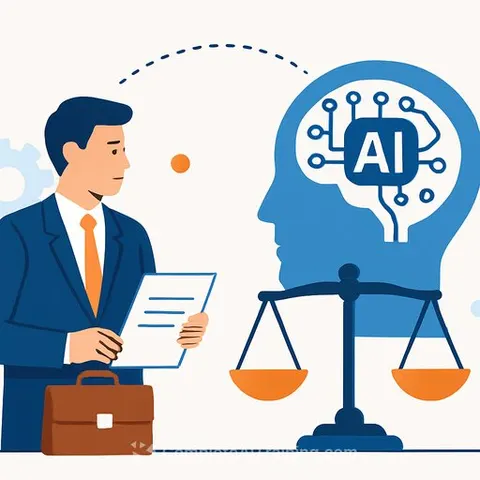
"We tend to overestimate the effect of a technology in the short run and underestimate the effect in the long run." Roy Amara's decades-old observation, known as Amara's Law, captures the current debate over artificial intelligence in the legal field. Predictions are everywhere, but the history of large-scale infrastructure offers a humbling lesson in how little we actually know about what comes next.
A recent USA Today article by Leslie D. Rose, marking the 70th anniversary of the interstate highway system, laid out how a project built primarily for national defense ended up reshaping American life in ways no planner envisioned. The same pattern of unforeseen consequences likely applies to AI and the law.
The interstate highway's unforeseen ripple effects
Before interstates, trucks handled local pickup and short-haul routes. The connected highway network made cross-country shipping cheaper and faster, which birthed the modern long-haul trucking industry. That shift enabled just-in-time manufacturing, altered supply chains, and transformed commercial transportation. Nobody in the 1950s predicted semi-trailers would come to dominate the roads.
The system also rewired how Americans perceive time and distance. Trips that once felt long - 50 miles - became routine commutes. Suburbs expanded. Vacation patterns changed. Public transit use declined as car culture took hold. These behavioral shifts took decades to fully materialize, and they were largely absent from early discussions about the highway program.
There was a darker side. Highway routes cut through neighborhoods with little political power, destroying homes and dividing communities. Smaller towns and businesses along old local roads lost traffic and customers. Some withered into ghost towns. The cultural cost - a thinning of rural America and its institutions - was a second-order effect no one had on the whiteboard.
Parallels for AI in the legal profession
If four-lane highways produced consequences this far-reaching and unpredictable, the same caution applies to AI. Current conversations focus on document review acceleration, legal research, and drafting. Those are the short-term, visible effects. The bigger shifts will likely arrive years later, from directions the profession is not watching.
AI could drive new service delivery models that fundamentally change the legal ecosystem. Just as interstates rewired trucking, new ways of handling legal matters may alter how courts operate, what it means to be a lawyer, and how businesses solve disputes. The idea of a two-week trial or a month-long arbitration could become as outdated as a 50-mile journey feeling like an expedition. Entire approaches to dispute resolution may shift as expectations around speed and cost recalibrate.
Those exploring AI for Legal applications are already seeing early signals. But the deeper structural changes - to billing models, firm hierarchies, and the attorney-client relationship - remain largely unexamined.
The hidden costs no one predicted
As with highways, the costs will not fall evenly. Firms and lawyers who cannot afford AI tools risk marginalization. Tech-savvy megafirms that maximize automation could pull work away from smaller practices, widening the legal desert problem in rural and underserved areas. The lawyers who once anchored small-town civic life - serving on school boards, leading local government, running modest practices - may find their economic footing gone.
Many of those practitioners relied on a mix of hourly billing and the occasional contingency fee case that made the year. National firms already absorb much of that contingency work. Local business clients that paid the billable hours are disappearing. AI could accelerate both trends. The Atticus Finch archetype - the lawyer embedded in and accountable to a specific community - faces an existential threat.
Beyond individual practitioners, the profession's cultural residue is at stake. Law has already shifted from a "learned profession" toward a pure business model. What remains of collegiality, firm loyalty, and the idea of law as a calling could erode further under pressure from automation and consolidation. Few anticipated that interstate highways would hollow out entire towns. The legal equivalent may be the hollowing out of local legal culture itself.
Why this matters for legal professionals
The lesson from Amara's Law and the interstate experiment is not that prediction is futile, but that certainty is the enemy. Lawyers and firms that lock themselves into fixed beliefs about where AI will lead - or that dismiss the technology's long-term potential - risk standing still while the road gets built around them. The practical step is to build technical literacy now. For paralegals and support staff, following an AI Learning Path for Paralegals creates a foundation that holds value regardless of which specific predictions prove right. Staying open to opportunity while watching for second-order effects is the closest thing to a strategy for an uncertain road ahead.