
AI news ·
Toyota estimates it needs 400,000 factory robots for modernization push
Toyota estimates factory modernization will require 400,000 robots and ¥1 trillion ($6.4 billion) annually starting in 2028. GXO and Exotec deployed a 127-robot system processing 40,000-70,000 pieces daily at a Guess facility.
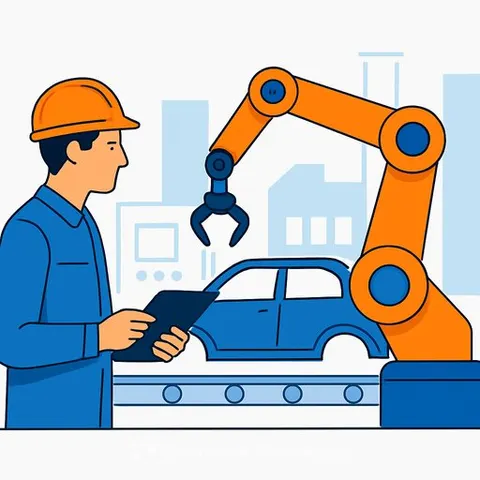
Toyota estimates factory modernization will require 400,000 robots and ¥1 trillion annually
Toyota estimates that modernizing its factories, group companies, and major suppliers will demand roughly 400,000 robots and about ¥1 trillion ($6.4 billion) in annual spending starting in 2028. The figure covers replacement machines and new automation across production, logistics, and human-robot collaboration - a scale that signals how the physical industry is rethinking labor, precision, and throughput.
The estimate arrives as manufacturers worldwide accelerate automation to offset labor shortages and improve quality. For operations leaders, the number is a benchmark: one of the world's largest automakers is betting that factory-floor robotics will become as routine as assembly-line tooling.
Warehouse robots scale to 70,000 pieces per day
GXO and Exotec have deployed a 127-robot Skypod system at GXO's Venlo facility for Guess. The system serves 60,000 rack locations and eight goods-to-person stations, processing 40,000 to 70,000 pieces daily with peak throughput reaching 2,200 order lines per hour. The installation shows how dense automation is compressing fulfillment timelines without expanding floor space.
AI inspection cuts scrap and speeds commissioning
Procter & Gamble is scaling an AI-based visual inspection system across its global manufacturing operations. Built on Siemens Industrial Edge, the system inspects delicate, variable products at full line speed and has reduced scrap by 10-20%. New installations are commissioned five to ten times faster than traditional bespoke vision systems.
Brazilian flat-glass producer Vivix Vidros Planos reported that an AI-powered Virtual Engineer, built with Siemens, cut production-issue resolution time by 85% and recovered 6,000 hours of manual work in one year. The assistant draws on plant, product, and process context rather than running as a standalone general-purpose model. These deployments point toward a pattern: AI is moving from pilot projects to production-grade tools that directly affect yield and downtime.
Data center construction meets energy and water constraints
Texas Governor Greg Abbott directed the state water board to pursue data centers that fail to report water consumption, sources, and conservation measures. Noncompliance can trigger enforcement referrals and make projects ineligible for environmental permits, while an earlier audit directive allows ERCOT to deny grid interconnection. The order adds permitting risk to a sector already navigating power bottlenecks.
In the UAE, planners are rethinking infrastructure design after Iranian attacks exposed the vulnerability of concentrated compute. One 10-square-mile, 5-gigawatt AI campus will likely be replaced by a network of smaller facilities, with underground construction, blast resistance, backup systems, and air defenses under consideration. Meanwhile, Google committed €13 billion to Finnish AI infrastructure and signed a 22-year power deal supporting the Loviisa nuclear plant through 2050 - combining data centers, grid siting, wind contracts, and a 94-megawatt battery. For real estate and construction professionals, these projects illustrate how energy siting, physical security, and water disclosure are becoming deal-breakers rather than afterthoughts.
Nvidia turns its own supply chain into an AI testbed
Nvidia and Palantir have deployed a sovereign supply-chain stack inside Nvidia's own operations, combining Nemotron models with Palantir's Ontology, Foundry, and AIP. The first production workflow targets materials allocation across thousands of suppliers supporting systems where a single Vera Rubin rack contains about 1.3 million parts. The project treats Nvidia's supply chain as a proving ground for the same AI infrastructure it sells to industrial customers.
Nissan is taking a more direct approach on the factory floor. The company is deploying heavy-payload autonomous mobile robots across its Smyrna, Tennessee body shop, absorbing work now performed by 64 forklift and tug operators. Those employees will move to other plant jobs. GE Appliances is building a live digital simulation of every process across every plant - at its 1.1-million-square-foot range plant in Georgia, people and automated arms produce a stove every 15 seconds while managers use live production data to diagnose performance.
Why this matters for operations, real estate, and construction
The week's developments converge on a single pressure point: physical industry is being rewired at a pace that demands new skills. Toyota's 400,000-robot estimate and Nissan's forklift-replacement rollout mean operations leaders must plan for workforce transitions alongside automation timelines. On the construction side, Google's nuclear deal, Texas's water-permit linkage, and the UAE's hardened-facility pivot show that data center projects now hinge on energy and regulatory strategy as much as concrete and steel. For professionals managing these transitions, the gap between pilot-scale AI and full-scale deployment is closing - and the infrastructure decisions made now will lock in operational constraints for years.
For teams building expertise in these areas, resources on AI for Operations and AI for Real Estate & Construction offer practical grounding in the systems reshaping factory floors and project sites.