
AI news ·
Travel marketers face a split search landscape as AI and Google serve different jobs
Google revised daily search volume upward from 9.1 billion to 13.7 billion, and 95% of ChatGPT users still use Google. AI engines cite third-party content 51% to 85% of the time, so offsite validation now drives brand visibility.
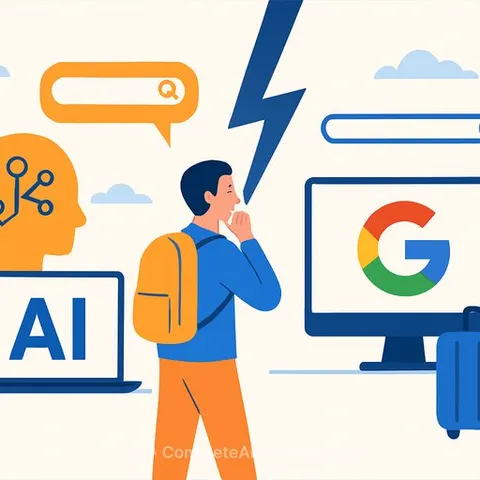
Travel marketers watching AI search developments face a flood of conflicting data. One analysis claims only 12% of links cited in Gemini appear in Google's top 10 results for the same prompt. Another study warns of an 86% drop in Reddit citations for ChatGPT. The volatility makes trend-chasing a losing strategy.
The search pie isn't shrinking; it's splitting by task. Similarweb data shows 95% of ChatGPT users in a given month also use Google. Google's daily search volume was recently revised upward from 9.1 billion to 13.7 billion searches per day. Consumers aren't abandoning traditional engines. They're assigning different jobs to different tools.
Organic search continues to drive high-volume brand navigation and high-intent queries, while AI handles discovery and complex, multicriteria research. For travel marketers, this means maintaining rigorous traditional SEO remains business-critical. Branded and high-intent keyword searches still capture ready-to-convert users today.
The hidden bonus: traditional and AI search share the same technical plumbing. Perfecting your sitemap, speed, and crawl efficiency ensures LLM crawlers can read, index, and cite your content. Teams looking to build these skills can explore AI SEO Courses that cover the technical foundations for both search environments.
AI engines cite content you don't own
For years, the SEO playbook centered on your own domain: authoritative content, clean structure, internal links. AI models don't play by those rules. Depending on which report you read, between 51% and 85% of what AI cites about brands is third-party content. "To get selected by AI bots, your offsite content is king. AI models trust community consensus far more than your slick onsite marketing copy."
Travel marketers should treat user-generated content and video as search content sources. LLMs treat forums like Reddit as high-signal environments. Engaging brand ambassadors to provide expert, non-promotional advice on relevant subreddits builds a digital footprint of helpfulness. When a brand appears repeatedly in positive, authentic contexts, AI perceives real-world consensus.
A hub-and-spoke approach to content repurposing increases the probability that an LLM cites your brand as a primary reference. A high-performing blog post about sustainable travel in Iceland can become an infographic on carbon-offset strategies and a series of short-form videos featuring specific locations. When dozens of independent sources confirm the same brand positioning, AI treats the repetition as verified fact.
Publishing proprietary, data-backed research on a strict schedule also helps. A recurring travel demand index transforms your brand into the go-to source other domains quote. Strategic timing matters too: most "best of" lists refresh annually, so time outreach to coincide with those refreshes.
AI collapses discovery and decision into one conversation
LLMs don't simply retrieve facts. They synthesize evidence from multiple sources to answer increasingly complex questions. Every time an AI system recommends a travel player, it weighs trade-offs, evaluates consumer requirements, and compares alternatives. Your content must explicitly answer who your product is most appropriate for, when your option should be chosen over a competitor, and what specific evidence supports those claims.
Traditional travel catalogues classify products using rigid checkboxes: Wi-Fi, pool, in-flight entertainment. AI conversations are granular and emotional. Instead of stating "fully equipped kitchen," explain that families can "save money and easily manage picky eaters with a modern, fully stocked kitchen." Framing basic amenities as solutions to specific traveler concerns provides the proof of value AI needs to recommend you.
Mine your existing data to find traveler constraints. Audit Google Search Console, Google Ads reports, onsite search logs, and customer service chat transcripts. Look for repeated constraints and inject "best for" scenarios into product descriptions. Treat every product page as a standalone homepage: surface localized trust signals, verified reviews, exact specifications, and policies to convert a visitor who arrives ready to buy.
The hybrid future
In May 2026, Google published its "How to use conversational attributes" guide in Merchant Center. By introducing six new conversational data points, Google gave brands access to its back-end systems to enhance generative AI search experiences. The buyer's journey is undergoing its most significant structural shift since the Google search bar arrived.
Visibility in the AI era is a compounding loop. Technical accessibility ensures you are found. Shaping brand content on external sites ensures LLMs trust you. Reframing product details into user-centric traveler solutions allows AI to evaluate, compare, and recommend your brand. If you neglect the technical foundation, your content is invisible to LLMs. Without third-party validation, your brand won't be cited. Without addressing traveler constraints, your products won't be recommended.
For marketing professionals, the broader implications extend beyond travel. The same principles apply to any industry where AI search is reshaping discovery. Resources on AI for Marketing offer context on how these shifts affect campaign strategy, content planning, and performance measurement across sectors.
Why this matters for marketers
The practical takeaway is sequencing. Traditional search traffic may shrink gradually, but it pays the bills today. AI recommendations secure your position in top-of-funnel conversations and serve as an entry point to agentic commerce. Audit your technical foundation first, build third-party validation second, and reframe product content around traveler constraints third. Each phase amplifies the next, and skipping one breaks the loop.