
AI news ·
Twilio expands into AI-powered customer conversations with new orchestration tools
Twilio launched AI orchestration tools including warm handoffs between AI and human agents, and its messaging revenue-about 60% of the business-grew roughly 18% in the first half of the year.
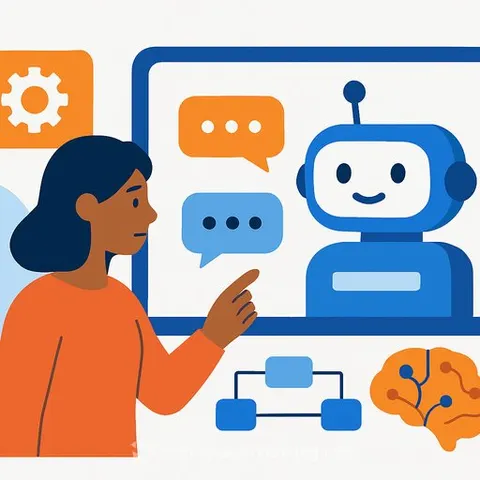
Twilio is pushing deeper into AI-powered customer conversations with a set of new orchestration tools, moving beyond its core communications connectivity business. The company outlined the strategy at a Goldman Sachs event, detailing products that coordinate AI agents, human agents, and multichannel interactions. For customer support teams, the shift signals a future where AI handles more complex conversations while preserving context across channels and handoffs.
Three layers of conversation tools
Chief Product and Technology Officer Inbal Shani described Twilio's platform as three layers: communications channels, contextual data, and AI agents operating across those channels. The company recently launched Conversation Memory, Conversation Orchestrator, and Conversation Intelligence. Shani said the goal is to use real-time context to make AI agents "more effective, more productive, more accurate."
Conversation Memory preserves context across customer interactions without duplicating data already stored in CRMs and data warehouses. Twilio is building connectors to those systems and retaining only the information most relevant to the interaction. Beta customers shaped one of the most practical features: a "warm handoff" between an AI agent and a human agent, plus the ability to detect when escalation is needed. Some beta users also adopted the tools for sales, identifying leads outside business hours and transferring them later.
Voice AI remains early but advancing
Twilio said voice AI adoption is still in early stages. Accuracy remains the primary barrier to deploying voice AI agents at scale. Latency, voice quality, turn detection, background noise, and network variability all continue to challenge the industry. Shani also pointed to trust and regulation as significant hurdles, including identity verification, monitoring, data storage, and evolving compliance requirements.
The company's AI for Customer Support approach remains model-neutral. Twilio's ConversationRelay product already lets customers bring their own speech-to-text, text-to-speech, and large language models. "We do not think there is going to be only one," Shani said, referring to AI models and agents. Customers are likely to use multiple models for different workloads. Twilio expects conversations to span multiple channels over a customer's lifetime, from marketing to sales, support, and re-engagement.
Growth numbers and margin drivers
Twilio reported broad-based organic revenue outperformance above 5% in each of the past two quarters. Messaging, roughly 60% of revenue, grew about 18% in the first half of the year. Voice revenue rose more than 20% in the second quarter. About half of that voice growth came from connectivity volume and half from software add-ons like conferencing, Media Streams, and Answering Machine Detection.
Higher-margin voice and software products, along with cost reductions from direct carrier connections and cloud migration, are supporting gross-profit growth. The company also noted that higher U.S. carrier fees have not yet produced a meaningful change in messaging demand, though customers have expressed dissatisfaction. Twilio continues to offer alternatives including WhatsApp and email.
Why this matters for customer support teams
Twilio's orchestration tools point toward a support environment where AI agents handle initial conversations, preserve full context, and hand off to humans only when necessary. The warm handoff feature and escalation detection directly address two friction points in hybrid AI-human support workflows. For supervisors managing these transitions, understanding how to configure and monitor such handoffs will become a core skill. The AI Learning Path for Call Center Supervisors covers practical approaches to optimizing these exact scenarios. As voice AI accuracy improves and latency drops, support teams should expect more customer conversations to start with AI, not with a human agent.