
AI news ·
US Court Ruling Gives AI Companies Green Light to Train on Copyrighted Books
A US court ruled AI training on legally purchased copyrighted books is fair use, favoring AI firms. UK law remains stricter, with key cases ongoing.
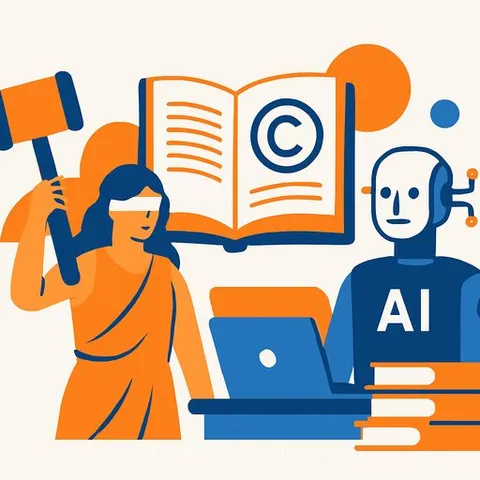
This US ruling just reshaped AI copyright law
What’s going on here?
A US court recently ruled that Anthropic, the AI company behind Claude (a competitor to ChatGPT), can legally train its AI models on copyrighted books - provided those books were purchased legitimately. This decision marks the first major win for applying the “fair use” doctrine to AI training.
Why is this decision important?
Courts face the challenge of balancing innovation with protecting creators' rights. This ruling has significant implications for both AI companies and content creators.
For AI companies:
This ruling is a game-changer. Previously, companies risked lawsuits by using copyrighted books for training, even if the books were legally obtained. The court confirmed that training AI on legitimately purchased books qualifies as “fair use.” This sets a strong precedent favoring AI-focused technology firms in the US.
For authors and publishers:
Authors and publishers argue that AI companies use their work without permission or compensation. This ruling is a setback for them. However, AI companies cannot use pirated content — they must buy books legally before using them for training. So, the decision doesn't grant total freedom but clarifies legal boundaries.
What is fair use, and how does it apply here?
“Fair use” is a US copyright law principle allowing limited use of copyrighted material without permission, typically for purposes like teaching or research. The new use usually must be “transformative," meaning it adds new meaning or purpose rather than merely copying.
In this case, the court found AI training to be transformative because the AI learns patterns and generates new content rather than reproducing the original books. The fact that Anthropic purchased the books legally strengthened their case.
How is UK law different from the US?
The UK does not have a “fair use” doctrine like the US. Instead, it has “fair dealing,” which is more restrictive and only permits unlicensed use in narrowly defined cases such as non-commercial research, criticism, or news reporting.
Currently, training AI models on copyrighted books is not clearly allowed under UK law, even if the books were purchased legally. A proposed 2022 copyright exception for AI training was scrapped after opposition from authors and publishers.
As a result, UK companies face higher legal risks and often need to obtain licenses from copyright owners, which can be costly and time-consuming.
So, what’s the position in the UK?
The UK is currently handling a pivotal case: Getty Images v Stability AI. This case, heard in the High Court in London, addresses whether training AI on copyrighted images violates UK law.
Getty Images alleges that Stability AI scraped millions of its images without permission to train the “Stable Diffusion” AI model, infringing copyright, database rights, and trademarks. Stability AI argues that the scraping occurred outside the UK, that the copied elements are minor, and that fair dealing applies since the AI imitates styles rather than reproducing exact images.
This case is similar to the Anthropic ruling but under UK law, which is less flexible. UK courts are expected to adopt a stricter stance on AI training practices.
How can you use this in your applications?
This case illustrates a real legal challenge for UK-based AI companies. It’s also a strong example to discuss in applications or interviews, showing how legal advice directly influences business decisions.
For example, a UK AI start-up planning to train models on millions of books and images might consult legal counsel to weigh options such as:
- Paying for licenses from publishers and image libraries to reduce legal risk.
- Relocating training operations to the US, where fair use provides stronger protection, despite added costs.
- Removing high-risk datasets, which could weaken their product against competitors.
- Delaying product launch until UK law or courts clarify the rules, risking falling behind US rivals.
These are practical trade-offs involving cost, speed to market, and risk. Lawyers help clients make informed decisions when the law is uncertain, balancing innovation with compliance. This mindset applies widely where business and regulation intersect.
If you’re interested in intellectual property work, consider firms known for IP, technology, or disputes practices such as Bird & Bird, Bristows, or Hogan Lovells. These firms handle high-impact disputes like this one, offering opportunities to help clients innovate while managing legal risks.