
AI news ·
Xeal launches Laitent edge compute network that runs on idle EV charging capacity
Xeal launched Laitent, an edge compute network that runs AI workloads on idle electrical capacity at over 1,600 U.S. EV charging sites. Each pod uses up to 90% of a site's unused power and can add up to $1 million in property value.
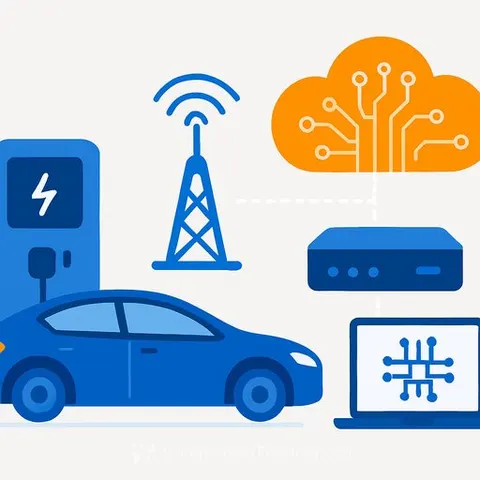
Xeal launched Laitent, a new edge inference compute network that will run AI workloads on idle electrical capacity already wired into EV charging stations. The company has more than 200 megawatts of permitted, installed infrastructure across 1,600-plus properties in the U.S., and it plans to deploy over 100,000 NVIDIA GPUs alongside that footprint. The first Laitent Pod, built with partner JVM Realty, is expected online by the end of 2026.
For real estate owners and managers, the model offers a way to generate revenue from electrical capacity that sits unused most of the time. EV charging sites are permitted for a maximum load but typically operate below 10% of that ceiling. Laitent routes the remaining 90% into GPU compute pods, creating what the company calls the Metro Edge - inference infrastructure located in metro areas, close to end users.
How the hardware fits on site
Each Laitent Pod occupies roughly one parking space and houses up to 48 NVIDIA Hopper or Blackwell Ultra GPUs. The pods use self-contained cooling that requires no water hookup, and they operate at less than 65 decibels - comparable to a washing machine. A NEMA 4 enclosure protects the equipment outdoors, and the units can be installed and running within hours.
Xeal's dynamic power orchestration software shifts idle energy capacity into the pod, scaling from a single GPU slice up to a distributed metropolitan network. The company said the Metro Edge placement delivers sub-20ms latency, a meaningful improvement over inference workloads sent to distant data centers.
Revenue and property value implications
Steve Boyack, Chief Operating Officer of JVM Realty, which has worked with Xeal since 2023, said the arrangement creates new income from infrastructure already in place. "For property owners, the combination of a new income stream with little-to-no upfront investment creates meaningful financial upside," Boyack said.
Xeal estimates a Laitent Pod can add up to $1 million in property value. All power bills are covered as a tenant passthrough, and site owners can choose between a fixed rental payment or ancillary revenue sharing. The company has secured partnerships with Rafay Systems for AI infrastructure orchestration, Spectrum Business for enterprise-grade fiber, and a Tier 1 inference provider for up to 5MW of compute.
Bypassing the grid interconnect bottleneck
The hardest part of bringing new compute online is the utility interconnection process. By using already-permitted electrical capacity, Laitent sidesteps that timeline entirely. Nikhil Bharadwaj, co-founder and CEO of Xeal, said, "If you need inference compute today and can't wait for a new data center to come online, Laitent can accelerate your timeline from years to months."
Marc Spieler, Senior Managing Director for the Global Energy Industry at NVIDIA, noted that AI infrastructure will need to become more distributed and energy-efficient. "By pairing NVIDIA accelerated computing with Xeal's existing grid-connected EV charging footprint, Laitent offers an innovative way to bring low-latency inference closer to users while making better use of infrastructure that has already been built," Spieler said.
Why this matters for real estate and construction professionals
Laitent turns an underused electrical asset - permitted capacity that sits idle - into a revenue-producing tenant with no new construction, no water infrastructure, and no generator or turbine requirements. For property managers and developers, the model fits into existing parking layouts, adds documented property value, and arrives with the power bill already covered. Xeal has built more than 1,600 EV charging sites over seven years and has teams operating in over 160 U.S. metro areas, which means the installation and maintenance playbook already exists. As the company looks to unlock more than 1 gigawatt of headroom across real estate portfolios, the opportunity scales well beyond the initial 200 megawatts.