AI agent for materials scientists
Failure Analysis Case Agent
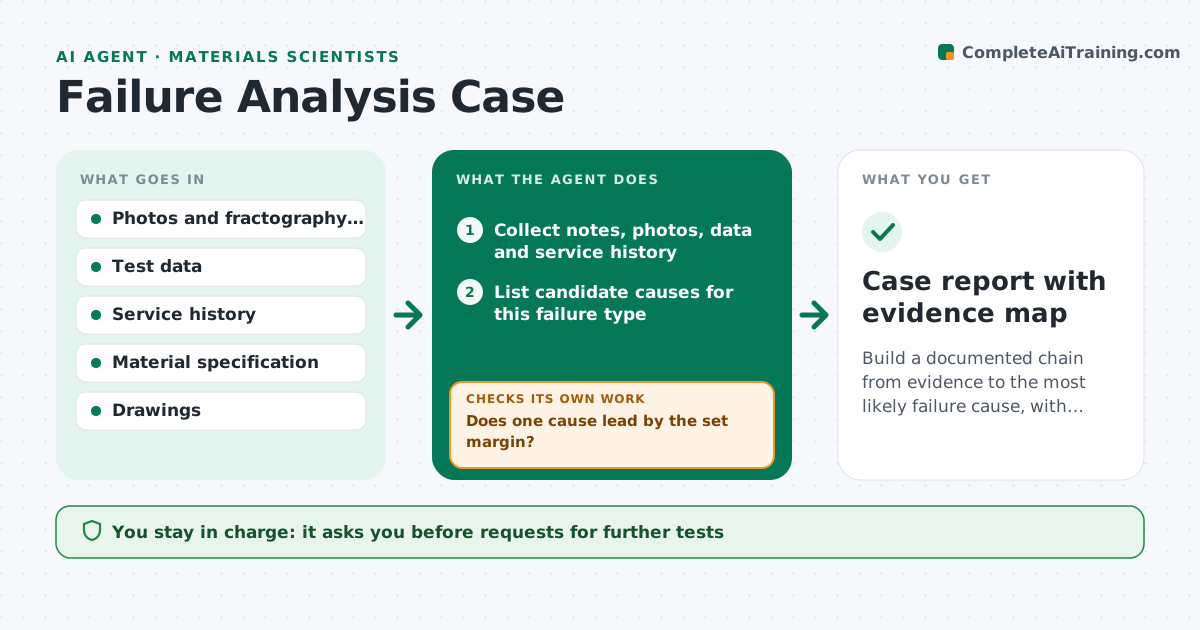
Build a documented chain from evidence to the most likely failure cause, with the tests needed to confirm it.
What it does
After a part fails, evidence piles up: photos, fractography notes, hardness readings, chemistry, service history. The conclusion often rests on the first plausible story. This agent collects the evidence into one case file and lists the possible causes, such as overload, fatigue, corrosion, hydrogen embrittlement or a material defect. For each one it scores how well each piece of evidence supports it or rules it out. It shows the ranking and lists what is missing, such as a section for microscopy or a chemistry test. When new results come in, it updates the scores and the ranking. It never states the cause. The analyst approves conclusions. Edge case: evidence that fits two causes is shown as ambiguous, not forced into one.
How it works
Follow the arrows from top to bottom. The orange dashed arrow is the loop: when a check fails, the agent goes back and tries again.
Read the steps as a list
- Case opened or evidence added
- Collect notes, photos, data and service history
- List candidate causes for this failure type
- Score each piece of evidence against each cause
- Rank causes and list evidence gaps
- Does one cause lead by the set margin?If not: propose the tests that would separate the top causes. Back to step 3.
- Analyst approves the tests to requestThe agent waits here for your OK.
- Read new test results and update the scores
- Does any evidence contradict the leading cause?If not: drop or lower that cause and rescore the others. Back to step 4.
- Analyst approves the conclusionThe agent waits here for your OK.
- Case report with evidence map
How it decides
It scores each cause by the evidence for and against it. A cause is dropped only when one piece of evidence rules it out, and the lead cause must beat the next by a margin before it is called likely.
- Call a cause likely only if it leads the next by 30% in score
- Drop a cause only on direct contradicting evidence
- List every missing test needed to separate close causes
- Mark conflicting evidence as ambiguous
Make it yours
Every agent is a starting point. You choose these settings for your own situation.
- Cause list by failure type
- Margin to call a cause likely (default 30%)
- Test list available
- Report template
- Evidence weights
What keeps you in control
It always asks you first
- Requests for further tests
- The final conclusion
Hard limits
- Never present a ranking as a final cause
- Keep contradicting evidence visible in the report
It stops when
- Done: one cause is supported and the analyst approves
- Stop: evidence cannot separate causes and no more tests are possible
Set it up
We guide you through the set-up, step by step
Members get the full set-up guide for this agent. No technical skills needed: you copy, paste and upload.
- One set of instructions to paste into your AI, with the clicks for ChatGPT, Claude, Microsoft 365 Copilot, Gemini and Grok
- The agent then walks you through connecting your own data, one source at a time
- A downloadable copy with the flow chart, the rules and the full guide