AI agent for postdoctoral researchers
Research Literature Update Agent
An up-to-date evidence map with every new study screened.
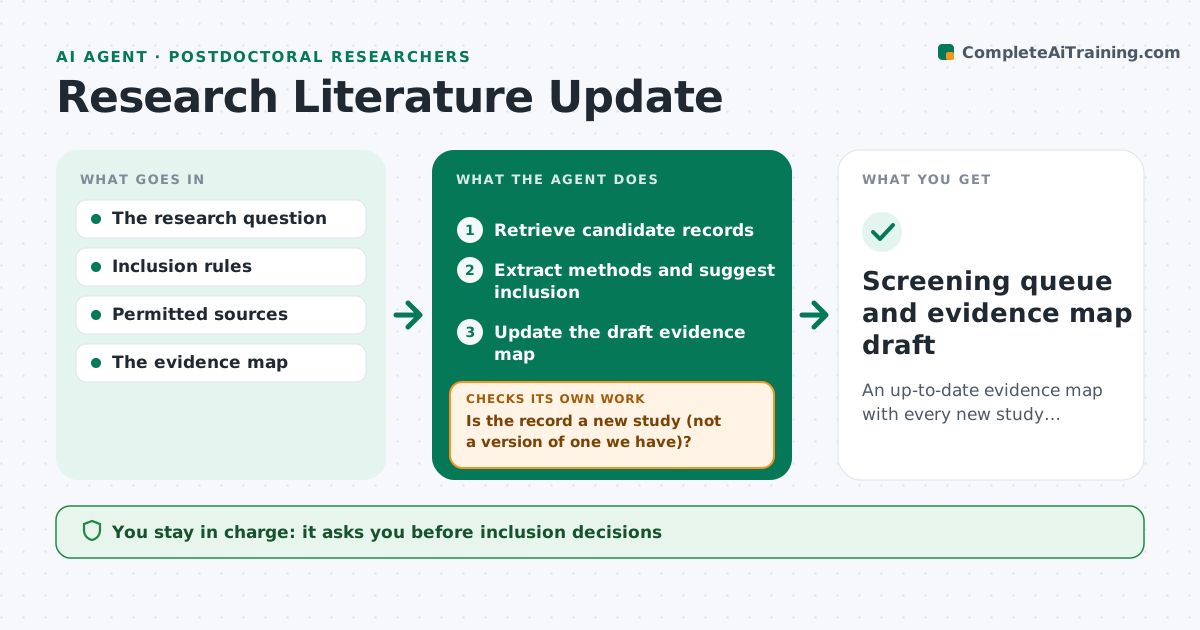
What it does
New studies are found every week, but the project's evidence map is not updated, so the team argues from an outdated picture. This agent runs a weekly literature search using the saved queries. It retrieves candidate records and deduplicates them, linking preprints to their later journal versions so one study is not counted twice. For each new study, it extracts the design, sample size and outcomes and suggests whether it meets the inclusion criteria, with the reason. It then updates a draft evidence map and marks every new finding as needing review. Investigators make the final inclusion decisions. Edge case: a conference abstract and a full paper from the same trial are linked as one study, even if the titles differ.
How it works
Follow the arrows from top to bottom. The orange dashed arrow is the loop: when a check fails, the agent goes back and tries again.
Read the steps as a list
- Weekly search
- Retrieve candidate records
- Is the record a new study (not a version of one we have)?If not: link it to the existing study. Back to step 2.
- Extract methods and suggest inclusion
- Update the draft evidence map
- Investigator decides inclusionThe agent waits here for your OK.
- Screening queue and evidence map draft
How it decides
It refines searches from screening gaps and deduplicates linked versions.
- A preprint and its journal version are one study.
- Inclusion suggestions cite the criterion met or failed.
- New findings stay marked for review until an investigator decides.
- Nothing is removed from the map without review.
Make it yours
Every agent is a starting point. You choose these settings for your own situation.
- Saved search queries and databases
- Inclusion criteria
- Run day (default: Monday)
- Fields to extract per study
- Who decides inclusion (default: lead investigator)
What keeps you in control
It always asks you first
- Inclusion decisions
- Conclusions
- Redistribution
Hard limits
- No redistribution of restricted texts.
It stops when
- Done: weekly screen complete.
Set it up
We guide you through the set-up, step by step
Members get the full set-up guide for this agent. No technical skills needed: you copy, paste and upload.
- One set of instructions to paste into your AI, with the clicks for ChatGPT, Claude, Microsoft 365 Copilot, Gemini and Grok
- The agent then walks you through connecting your own data, one source at a time
- A downloadable copy with the flow chart, the rules and the full guide