AI agent for historians
Primary Source Citation Chain Agent
Give each key claim a documented chain to its earliest source, with a check that the source supports it.
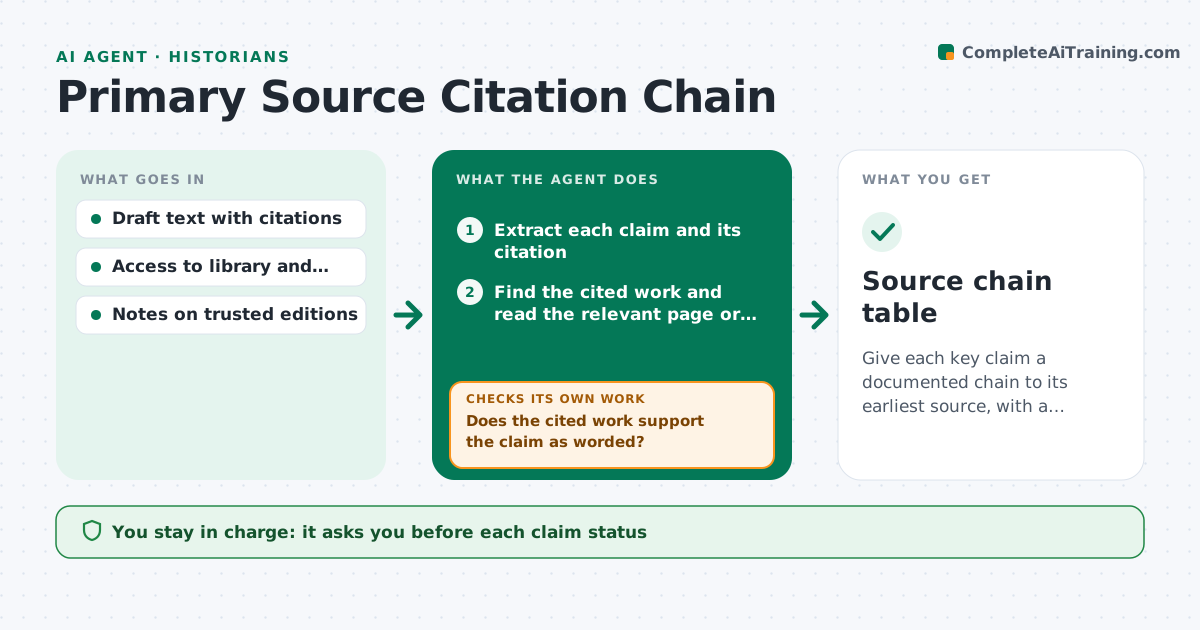
What it does
A historian reading a book may find that a striking claim rests on a footnote, which points to another book, which points to a letter nobody has checked. This agent takes a draft or a list of claims and traces each one back through its citations to the earliest source it can find. At each step it checks whether the cited work actually says what is claimed, and records where the chain breaks, loops or ends in nothing. When it finds a break, it searches archives, digital libraries and catalogs for the original and rechecks the claim against it. It reports every claim with a status: confirmed at source, unverified or contradicted. It never rewrites the argument. The historian approves each conclusion. Edge case: a quote that changes wording along the chain is flagged as drift.
How it works
Follow the arrows from top to bottom. The orange dashed arrow is the loop: when a check fails, the agent goes back and tries again.
Read the steps as a list
- Claims list submitted
- Extract each claim and its citation
- Find the cited work and read the relevant page or passage
- Does the cited work support the claim as worded?If not: mark a mismatch and look for the real source the author may have meant. Back to step 3.
- Follow that work's own citation to the earlier source
- Has the chain reached a primary source?If not: search archives and catalogs for the original, up to the search limit. Back to step 5.
- Compare wording at each link to detect drift
- Write a status per claim with the full chain
- Historian approves each status and any change to the textThe agent waits here for your OK.
- Source chain table
How it decides
It stops tracing when it reaches a primary source or a point where no earlier source can be found after a set number of searches. It rates the claim by how closely the earliest source matches the wording.
- Stop a chain after 5 links or 3 failed searches
- Mark a claim contradicted if the source says the opposite
- Mark wording drift if quote text differs at any link
- Prefer the earliest dated source over a later printed edition
Make it yours
Every agent is a starting point. You choose these settings for your own situation.
- Maximum links per chain (default 5)
- Catalogs and archives to search
- Which claims to trace (all or flagged)
- Citation style
- Editions to trust
What keeps you in control
It always asks you first
- Each claim status
- Any change to the historian's text
Hard limits
- Never present an unverified chain as confirmed
- Always give the page or location for each link
It stops when
- Done: every claim has a status and a chain
- Stop: source is not available online and needs a visit
Set it up
We guide you through the set-up, step by step
Members get the full set-up guide for this agent. No technical skills needed: you copy, paste and upload.
- One set of instructions to paste into your AI, with the clicks for ChatGPT, Claude, Microsoft 365 Copilot, Gemini and Grok
- The agent then walks you through connecting your own data, one source at a time
- A downloadable copy with the flow chart, the rules and the full guide