AI agent for corporate trainers
Role-Play Scenario Calibration Agent
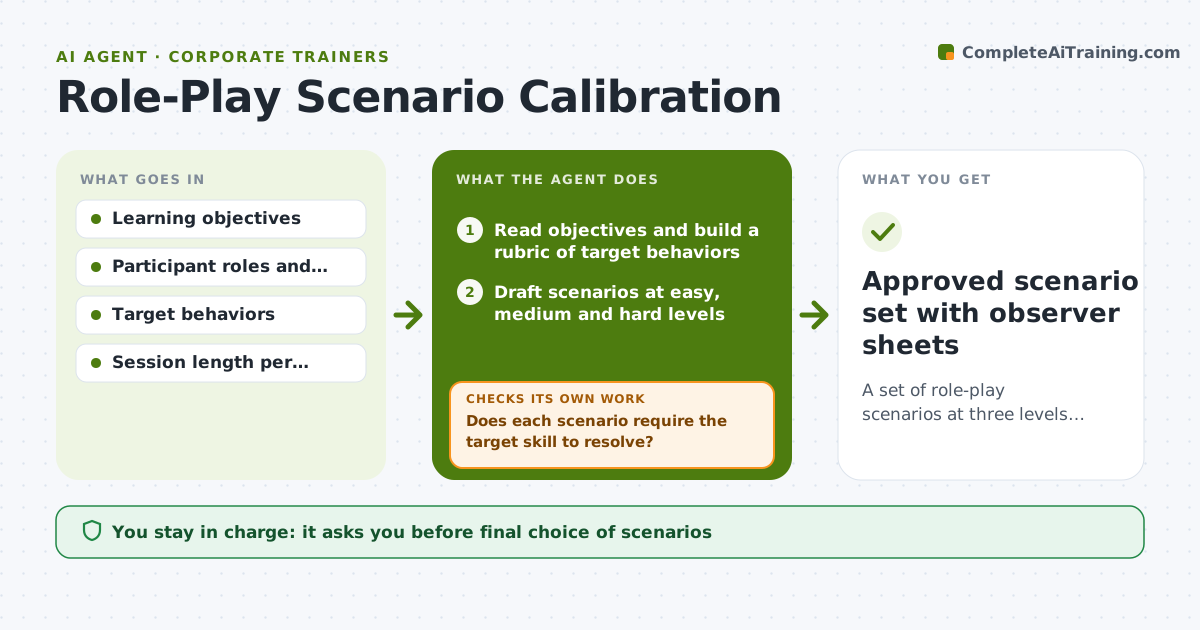
A set of role-play scenarios at three levels that each require the target behaviors.
What it does
Role-plays often miss the mark. The scenario is too easy, so nobody has to use the target skill, or too hard, so people freeze. This agent reads your learning objectives and participant roles and drafts scenarios at three difficulty levels. It then tests each scenario against a rubric built from the target behaviors, asking whether a participant could finish it without using the skill. If a scenario passes without needing the skill, the agent rewrites it to add a real obstacle, such as an upset customer or a missing fact. It also checks that the three levels differ in a meaningful way. Edge case: a coaching scenario for new managers only works if the employee has a believable reason to resist, so the agent adds one. You review the set and pick the scenarios to use.
How it works
Follow the arrows from top to bottom. The orange dashed arrow is the loop: when a check fails, the agent goes back and tries again.
Read the steps as a list
- Trainer shares objectives and participant roles
- Read objectives and build a rubric of target behaviors
- Draft scenarios at easy, medium and hard levels
- Test each scenario against the rubric
- Does each scenario require the target skill to resolve?If not: rewrite the scenario to add an obstacle that forces the skill. Back to step 3.
- Do the three levels differ by one clear difficulty step?If not: adjust the levels so each adds a single new challenge. Back to step 3.
- Add observer checklists and timing for each scenario
- Trainer reviews and picks the scenariosThe agent waits here for your OK.
- Approved scenario set with observer sheets
How it decides
A scenario passes only if the rubric shows the target behavior is needed to resolve it, and each level adds one new difficulty instead of a different topic.
- Reject any scenario that can be solved without using a listed behavior.
- Each level adds one difficulty, such as time pressure or an emotional customer.
- Scenario length must fit the time per role-play.
- Use roles and settings the group actually works in.
Make it yours
Every agent is a starting point. You choose these settings for your own situation.
- Number of levels (default 3)
- Role-play length in minutes
- Behaviors on the rubric
- Industry and setting
- Observer sheet format
What keeps you in control
It always asks you first
- Final choice of scenarios
- Any real company or person names used in scenarios
Hard limits
- Never use real employee or customer names.
- Do not mark a scenario as passing without checking it against the rubric.
It stops when
- Done: all scenarios pass the rubric and the trainer picked a set
- Stop: objectives are too vague to build a rubric, so the agent asks the trainer to clarify them
Set it up
We guide you through the set-up, step by step
Members get the full set-up guide for this agent. No technical skills needed: you copy, paste and upload.
- One set of instructions to paste into your AI, with the clicks for ChatGPT, Claude, Microsoft 365 Copilot, Gemini and Grok
- The agent then walks you through connecting your own data, one source at a time
- A downloadable copy with the flow chart, the rules and the full guide