AI agent for instructional designers
Instructor Assessment Variant Agent
New practice questions that test the intended objective at the intended difficulty, each with a verified answer.
What it does
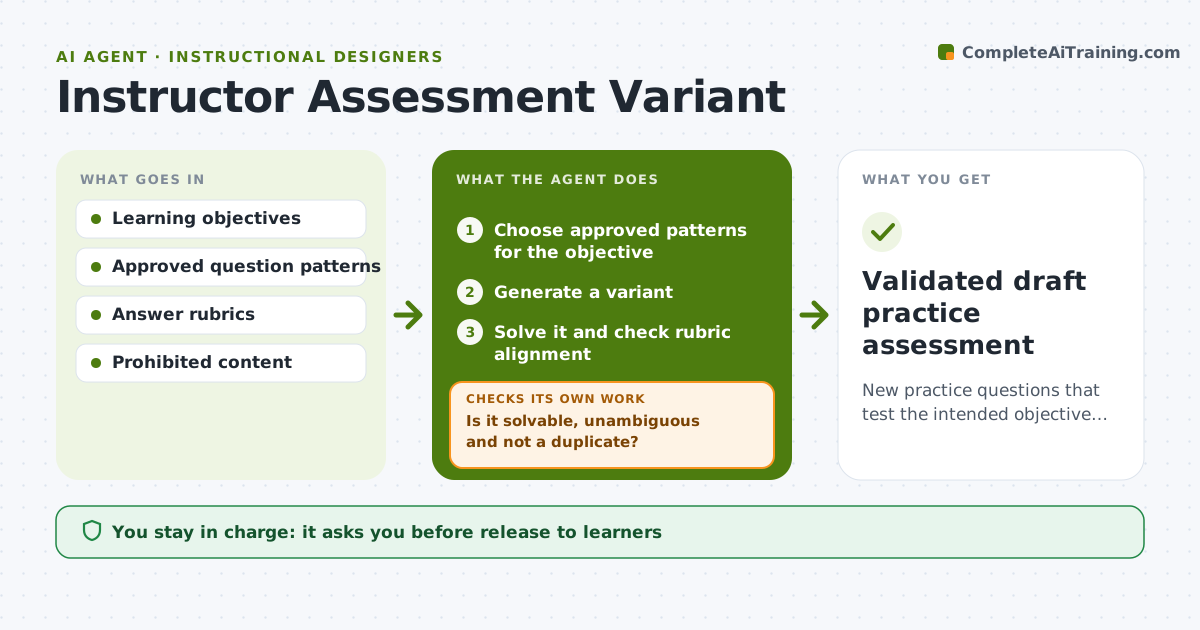
When course teams create new versions of test questions, the difficulty or learning objective can shift by accident, or a numeric question may have no valid answer. Learners then get unfair or broken items. This agent picks approved question patterns for the requested objective and generates variants. It solves each variant itself and checks it against the rubric and the objective. It also checks for duplicates of existing items and ambiguous wording. Any item it cannot solve, or that is unclear, is revised within the pattern's rules and solved again before it enters the draft. The assessment designer reviews the form with rationales and approves release. Edge case: a variant that is correct but much easier than the pattern's target difficulty is rejected.
How it works
Follow the arrows from top to bottom. The orange dashed arrow is the loop: when a check fails, the agent goes back and tries again.
Read the steps as a list
- Designer requests new variants
- Choose approved patterns for the objective
- Generate a variant
- Solve it and check rubric alignment
- Is it solvable, unambiguous and not a duplicate?If not: revise the item and solve again. Back to step 3.
- Assemble the review form with rationales
- Assessment designer approves releaseThe agent waits here for your OK.
- Validated draft practice assessment
How it decides
It picks patterns that cover the requested objective and are not yet used, solves each generated item, and revises infeasible or ambiguous items until they pass.
- Pattern choice: patterns that cover the objective and avoid existing items.
- Accept an item: solvable, unique, unambiguous and aligned with the rubric.
- Difficulty: reject variants that miss the pattern's target difficulty.
- Revise limit: after three failed revisions, drop the variant and generate a new one.
Make it yours
Every agent is a starting point. You choose these settings for your own situation.
- Number of variants per request (default 20)
- Similarity level that counts as a duplicate (default 85%)
- Difficulty range allowed per pattern
- Rationale format (default worked solution plus rubric reference)
- Who approves release (default the assessment designer)
What keeps you in control
It always asks you first
- Release to learners
- Use in exams
Hard limits
- Not used for high-stakes exams without approval.
It stops when
- Done: requested number of items pass.
Set it up
We guide you through the set-up, step by step
Members get the full set-up guide for this agent. No technical skills needed: you copy, paste and upload.
- One set of instructions to paste into your AI, with the clicks for ChatGPT, Claude, Microsoft 365 Copilot, Gemini and Grok
- The agent then walks you through connecting your own data, one source at a time
- A downloadable copy with the flow chart, the rules and the full guide