AI agent for astronomers
Transient Candidate Vetting Agent
A short ranked list of credible transients with evidence, so follow-up time goes to real objects.
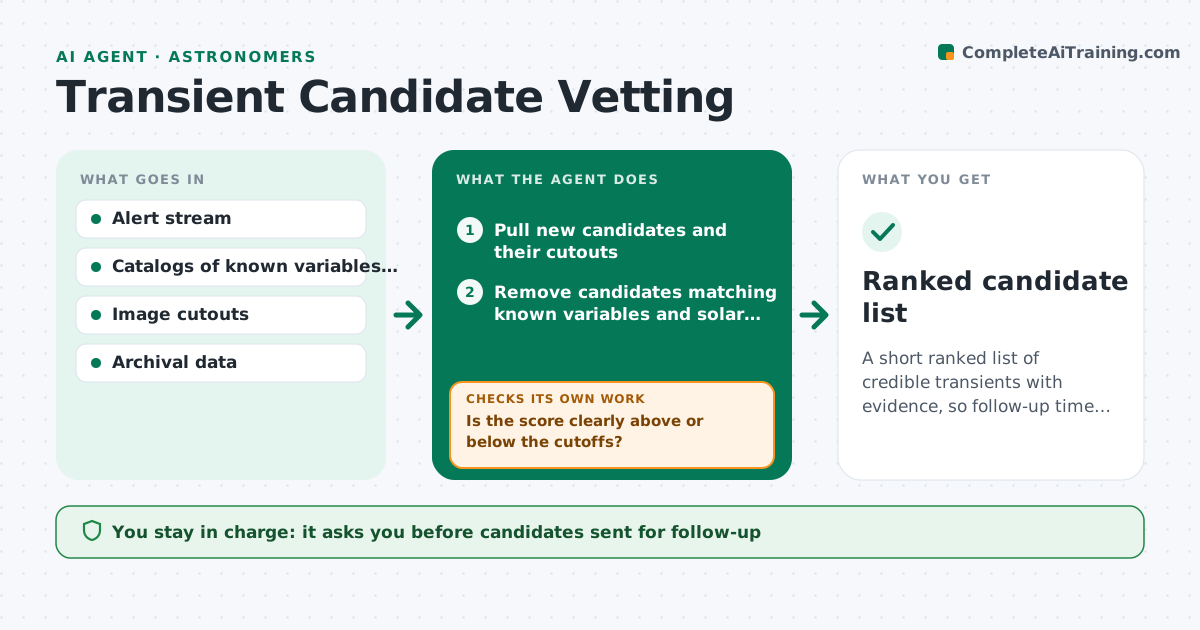
What it does
A nightly alert stream can hold thousands of candidates, and most are image artifacts, asteroids or known variable stars. This agent pulls the new candidates each morning. For each one it checks catalogs and known variable lists, looks at image quality flags such as bad subtraction, edge position or cosmic ray, and checks for earlier detections. It then scores the likelihood that it is a real new transient. Borderline cases get extra checks such as archival images or a check of the host galaxy, and the score is recomputed. You get a ranked list with the evidence for each. You approve which candidates go to a follow-up request. Edge case: objects near bright stars have quality flags weighed differently.
How it works
Follow the arrows from top to bottom. The orange dashed arrow is the loop: when a check fails, the agent goes back and tries again.
Read the steps as a list
- Morning alert stream available
- Pull new candidates and their cutouts
- Remove candidates matching known variables and solar system objects
- Check image quality flags and detection history
- Score each remaining candidate
- Is the score clearly above or below the cutoffs?If not: pull archival images and host galaxy data for the borderline candidate. Back to step 3.
- Recompute the score with the added evidence
- Did the evidence resolve the borderline case?If not: mark it as uncertain and list what extra data would settle it. Back to step 6.
- Rank candidates and write evidence notes
- Astronomer approves which candidates go to a follow-up requestThe agent waits here for your OK.
- Ranked candidate list
How it decides
It combines quality flags, catalog matches and archival history into a score. Candidates between the lower and upper cutoff get extra checks before ranking.
- Match to a known variable within the set radius: exclude
- Detection only in one band and at the image edge: lower the score
- Archival detection at the same position in older images: classify as variable or AGN
- Score between 0.4 and 0.7: run archival checks before ranking
Make it yours
Every agent is a starting point. You choose these settings for your own situation.
- Score cutoffs (default 0.4 and 0.7)
- Catalogs to match
- Match radius
- Number of candidates to list
- Run time
What keeps you in control
It always asks you first
- Candidates sent for follow-up
- Any public report of a transient
Hard limits
- Never submit follow-up requests or public reports
- Never drop a candidate without logging the reason
It stops when
- Done: ranked list delivered
- Stop: alert stream unavailable
Set it up
We guide you through the set-up, step by step
Members get the full set-up guide for this agent. No technical skills needed: you copy, paste and upload.
- One set of instructions to paste into your AI, with the clicks for ChatGPT, Claude, Microsoft 365 Copilot, Gemini and Grok
- The agent then walks you through connecting your own data, one source at a time
- A downloadable copy with the flow chart, the rules and the full guide