AI tool
Actian VectorAI DB
Portable vector DB for edge, on‑prem, and cloud with a single API. Low-latency, high-throughput from Raspberry Pi to Jetson; runs in Docker, Python/JS SDKs, LangChain/LlamaIndex support, SOC2/HIPAA/GDPR-ready.
About Actian VectorAI DB
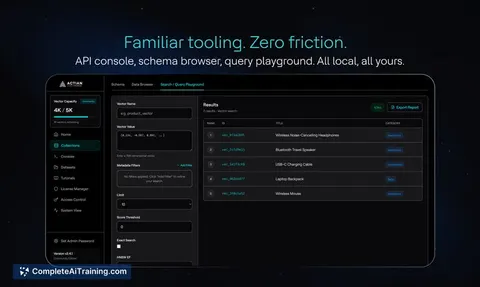
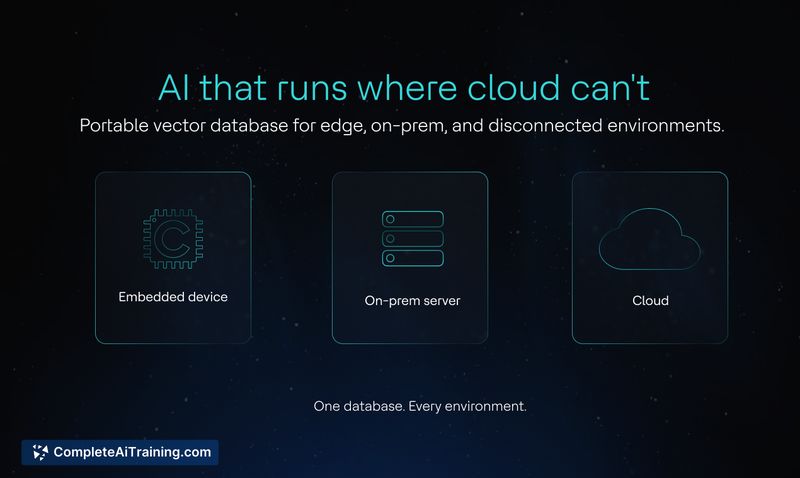
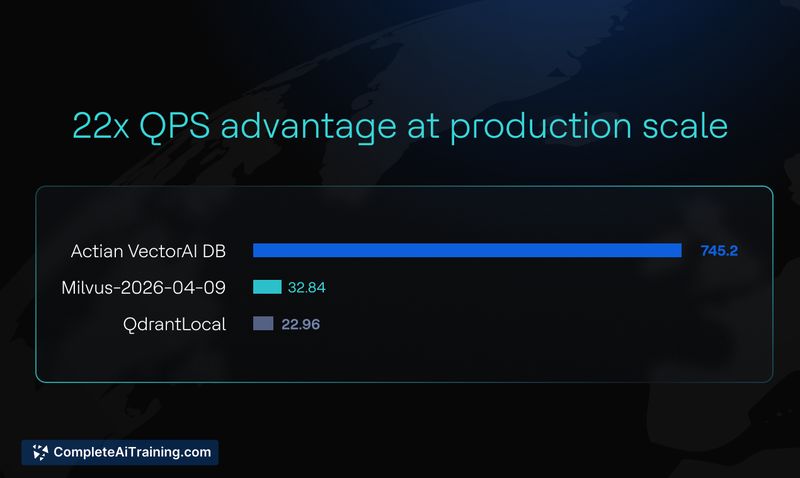
Actian VectorAI DB is a portable vector database built to run AI workloads outside of cloud-only environments. It enables local storage, retrieval, and reasoning with low-latency vector search on embedded, edge, on-prem, hybrid, and cloud deployments, and reports a 22x QPS advantage over two popular alternatives at 10M vectors in vendor-neutral benchmarks.
Review
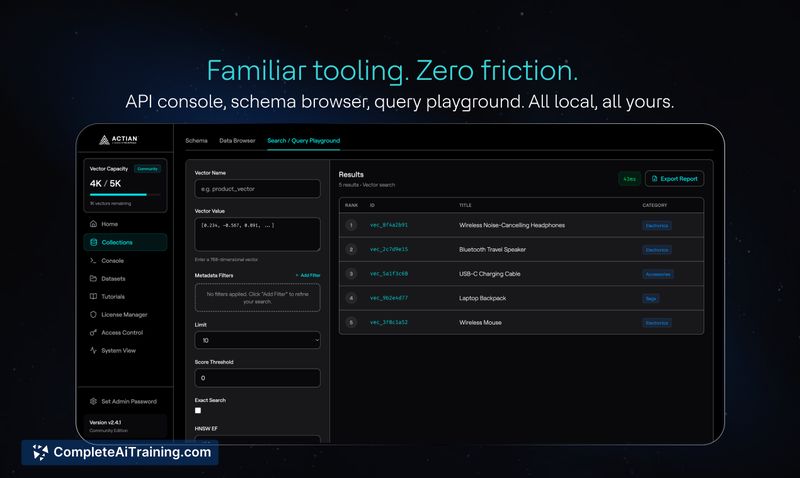

This review summarizes the main capabilities, integrations, and trade-offs of Actian VectorAI DB based on public product information and benchmark claims. I cover its primary features, pricing signals, practical benefits, and areas where teams should evaluate further.
Key Features
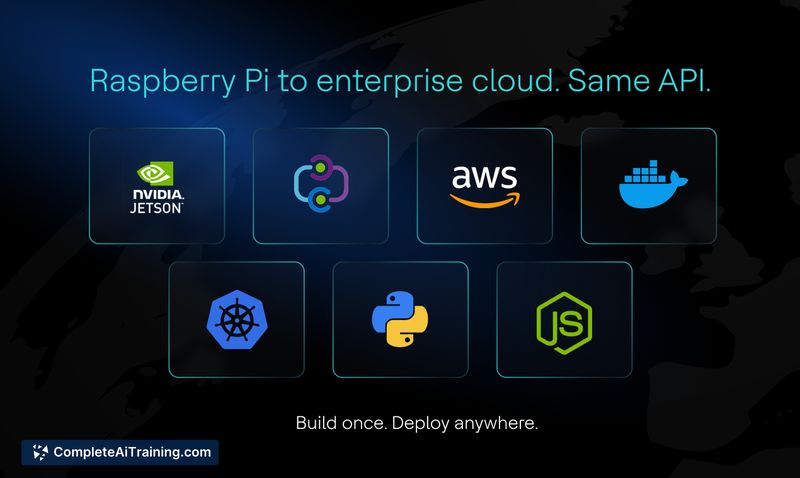
- Portable deployment: runs on devices from Raspberry Pi and NVIDIA Jetson to on-prem servers and cloud, with the same API and architecture for consistent behavior.
- Edge-first operation: supports local, zero-to-low bandwidth use cases and claims to retain strong throughput at scale in self-hosted tests.
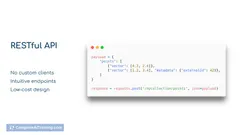
- SDKs and integrations: provides Python and JavaScript SDKs and compatibility with LangChain, LlamaIndex, and Hugging Face workflows.
- Flexible deployment: distributed as a Docker container and compatible with Kubernetes, Helm, and Terraform; supports Linux and Windows on ARM and x86.
- Compliance and enterprise readiness: lists ISO 27001, SOC 2 Type II, HIPAA, and GDPR compliance as supported frameworks.
Pricing and Value
Public information indicates a community edition and a free trial are available, with a paid commercial offering implied for production and enterprise use. Detailed tiered pricing is not published publicly, so teams that need predictable costs or enterprise SLAs should contact the vendor or request a trial. The key value proposition is local control of data, predictable low-latency behavior for edge/on-prem deployments, and compliance support that can simplify regulatory requirements for sensitive data.
Pros
- Consistent API and deployment model across edge, on-prem, hybrid, and cloud reduces rework when moving workloads between environments.
- Reported strong throughput at scale in independent-style benchmarks, which is attractive for high-query-rate scenarios.
- Offline and low-bandwidth operation makes it suitable for disconnected or intermittently connected devices.
- Good ecosystem fit with SDKs and integrations that many developers already use for vector-based applications.
- Compliance certifications listed, which can accelerate adoption in regulated industries.
Cons
- Newly launched product means the community, third-party tooling, and long-term operational history are still developing compared with established alternatives.
- Public materials leave open questions about storage footprint, real-world write/update performance, and index merging behavior in hybrid sync scenarios-these should be validated with representative workloads.
- Migration effort may be nontrivial for teams already standardized on other vector databases; evaluate SDK compatibility and migration paths before committing.
Overall, Actian VectorAI DB is a strong candidate for teams that must run vector search outside the cloud-embedded devices, industrial edge, on-premises deployments, or hybrid setups where data residency and offline operation matter. Prospective users should try the community edition or trial to validate performance, storage characteristics, and integration fit with their existing pipelines before adopting it for critical production workloads.
Jobs Actian VectorAI DB suits
We checked Actian VectorAI DB against 500+ jobs; these get the most out of it.
Alternatives to Actian VectorAI DB
Other tools that do the same main job. Our AI compared Actian VectorAI DB with similar tools and kept the ones you could use instead.