About Assemble
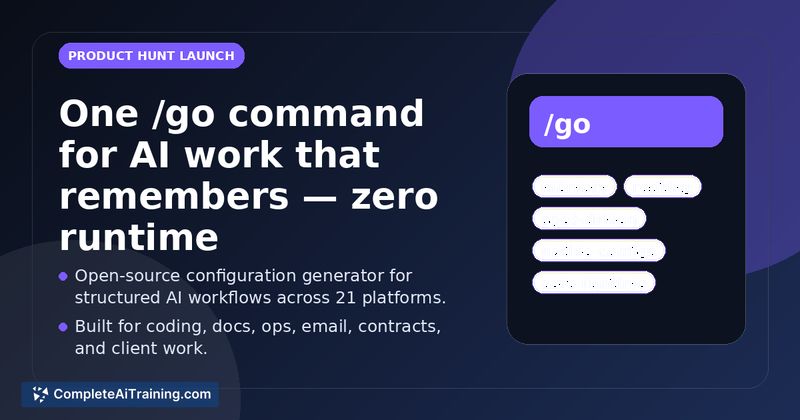
Assemble is an open-source configuration generator for AI work that provides a single /go command to start tasks with persistent context and structured workflows. It focuses on spec-driven processes and uses file-based memory so work can move between tools without adding a runtime layer.
Review
Assemble targets developers and teams who want repeatable, portable AI-driven workflows without introducing an always-on runtime or vendor lock-in. It combines simple command-based invocation with configuration files and persistent Markdown memory to keep context consistent across sessions and platforms.
Key Features
- /go command to initiate AI tasks with consistent routing by difficulty and workflow type.
- Open-source configuration generator that emits native configs for 21 platforms, avoiding a separate execution daemon.
- Persistent memory stored as Markdown files so context can persist across tools and sessions.
- Spec-driven workflows and staged boards for review and testing of larger deliverables.
- Built-in role templates and mechanisms to surface dissent and reduce overly agreeable outputs from models.
Pricing and Value
Assemble is distributed under an MIT license and is available for free. Its value proposition lies in providing a portable, configuration-first approach that reduces dependency on vendor runtimes and proprietary memory systems. For teams that need consistent, repeatable AI processes and want to own their context files, Assemble offers a low-cost way to standardize workflows and reduce time spent re-iterating generic outputs.
Pros
- Open-source MIT license: code and configs are portable and auditable.
- Zero runtime: no daemon, SDK, or always-on orchestration required, which minimizes infrastructure overhead.
- Markdown-based memory makes persistence readable, portable, and platform-agnostic.
- Spec-driven workflows and staged review help move complex tasks from idea to deliverable more reliably.
- Supports many target platforms via native config generation, enabling broad toolchain integration.
Cons
- Authoring good specs and configs requires upfront investment and some familiarity with prompt/config design.
- Platform parity can vary; not every target will behave identically and some integrations may feel more first-class than others.
- File-based memory and config-first approach may be less approachable for users seeking a polished GUI experience out of the box.
Assemble is best suited for developers, ops teams, and technical product teams who prefer configuration-driven workflows and want to keep control of context and execution without introducing new runtimes. It's particularly helpful for multi-step projects and use cases where consistency, auditability, and portability matter. For smaller, one-off tasks or users who prefer fully managed interfaces, a different tool with more graphical workflow support may be a better fit.
Open 'Assemble' Website
Your membership also unlocks: