About Aura
Aura is semantic version control that sits on top of Git and is built for workflows that involve AI coding agents. Instead of tracking text diffs, Aura hashes Abstract Syntax Trees (ASTs) to provide precise traceability for AI-generated changes, and the core engine is available under the Apache 2.0 open source license.
Review
Aura targets a clear pain point: AI agents can generate large, non-linear edits that break standard line-based version control and create difficult merge conflicts. It replaces text-based diffs with AST-aware tooling that lets teams block undocumented AI commits, surgically revert individual functions, and inspect the semantic impact of automated changes before they land.
Key Features
- AST-based semantic tracking: hashes the code's AST rather than lines to identify exact logic node changes and dependencies across a repository.
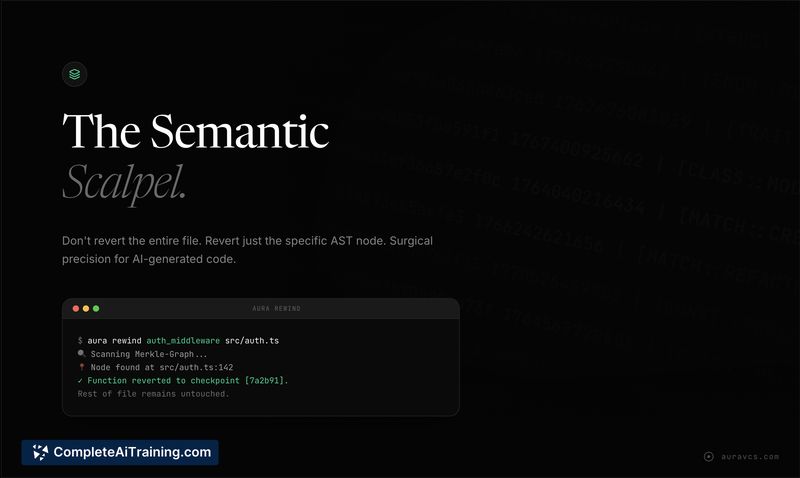
- Function-level recovery and memory controls: the Semantic Scalpel (aura rewind) reverts single broken functions, and the Amnesia Protocol (--amnesia) removes specific AI hallucinations from agent memory.
- Commit gating and allowlist: the Gatekeeper (aura capture-context) blocks commits whose natural-language intent doesn't match modified AST nodes, with a sovereign allowlist for approved exceptions.
- Orchestration and dependency mapping: aura plan builds execution waves from a repository Merkle-Graph to coordinate large-scale code generation and surface blast-radius impacts across files.
- Token-efficient handover and local operation: aura handover compresses architectural context into a dense format to reduce LLM token usage (claimed up to ~95% savings), and the tool runs 100% locally.
Pricing and Value
The core engine is released under the Apache 2.0 license and is available for free as open source. Value comes from reducing the engineering overhead caused by AI-generated merge conflicts, lowering LLM API costs through compact context handovers, and preventing undocumented or misaligned AI commits before they enter the codebase. For teams that already invest in LLMs and autonomous agents, Aura can produce operational and cost benefits without requiring cloud code access since it runs entirely locally.
Pros
- Provides precise, node-level traceability for AI-generated edits, which reduces noisy merge conflicts.
- Enables surgical reverts of specific functions instead of full PR rollbacks, saving developer time.
- Blocks undocumented or misaligned AI commits with a mathematical intent check, improving safety.
- Open source (Apache 2.0) and local-first, so code and context remain on-premise.
- Can materially reduce LLM token use when handing work between agents, lowering API costs.
Cons
- New workflow concepts (AST-based hooks, Merkle-graphs, intent capture) require onboarding and some integration work into existing CI/CD pipelines.
- Language support is focused on TypeScript/JS (including React/JSX), Python, and Rust; other languages may be unsupported or less mature initially.
- It does not replace human code review entirely-teams will still need reviewers for design, security, and higher-level judgement.
Overall, Aura is best suited for engineering teams that rely on AI agents to generate code and need stronger guardrails and provenance for those edits. It is particularly useful for groups willing to adopt AST-based workflows and who want a local, open source solution to reduce merge friction and LLM token costs.
Open 'Aura' Website
Your membership also unlocks: