About BIOS
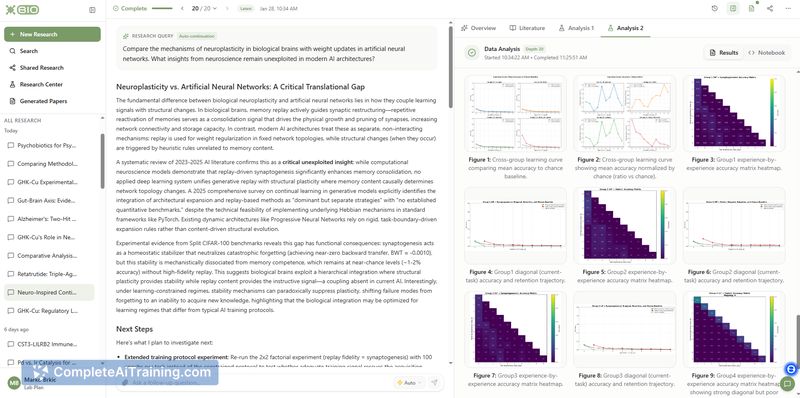
BIOS is an AI Scientist focused on biomedical research and biological data analysis. It combines automated agents with human-in-the-loop checkpoints so users can choose between guided control or fully autonomous runs.
Review
BIOS positions itself as a research-focused agent suite, having ranked #1 on BixBench for biological data analysis. It emphasizes flexible operation modes and a multi-agent architecture to support literature review, data analysis, orchestration, and novelty detection.
Key Features
- Three operation modes: steering (human-guided checkpoints), smart (balanced control), and autonomous (continuous runs).
- Four specialized agents handling orchestration, literature review, data analysis, and novelty detection.
- Human-in-the-loop checkpoints that update the agent's plan rather than forcing a full rerun.
- Benchmarked performance on biological datasets (ranked #1 on BixBench) with a focus on extended investigations.
- Free tier available and temporary full access for academic users with .edu addresses.
Pricing and Value
BIOS offers a free tier and provides full access to academic users with .edu email addresses for a limited time, which is attractive for researchers and students. The public listing does not detail specific paid tiers or pricing structures, so organizations that need sustained, large-scale runs should confirm commercial plan limits and costs before committing. The value proposition centers on saving researcher time by reducing repeated reruns through checkpoints and offering specialized agents focused on biological data work.
Pros
- Top-ranked on BixBench for biological data analysis, indicating strong benchmark performance.
- Flexible control modes let users intervene or run experiments end-to-end.
- Specialized agents cover core research tasks: literature review, data analysis, novelty detection, and orchestration.
- Checkpoint system updates the plan mid-run, reducing wasted computation and iteration time.
- Academic users can access full features for free for a limited period, lowering the barrier for research adoption.
Cons
- Public information lacks detailed pricing and limits for paid plans, which may complicate budgeting for larger projects.
- Using long autonomous runs may incur significant compute costs; users should evaluate resource needs beforehand.
- There is a learning curve to get the most from agent orchestration and checkpoint workflows.
BIOS is best suited for biomedical researchers, academic labs, and data scientists who work with biological datasets and need flexible experiment control or extended automated analyses. It is particularly appealing to groups that can take advantage of the academic access offer and those who prioritize a data-analysis-focused agent pipeline.
Open 'BIOS' Website
Your membership also unlocks: