AI tool
Blaxel Agent Drive
Blaxel Agent Drive provides shared file storage for AI agents operating across multiple sandboxes. It manages concurrent read and write access to prevent file corruption when multiple agents interact with the same data.
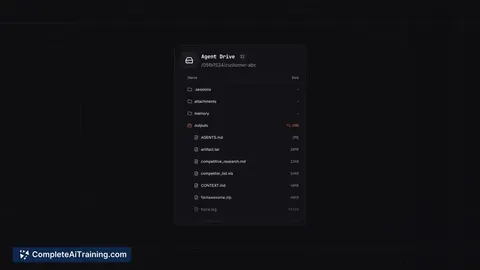
About Blaxel Agent Drive
Blaxel Agent Drive is a distributed filesystem that multiple sandboxes can mount simultaneously with concurrent read-write access. AI agents interact with it through a normal filesystem path, sharing files, tool outputs, datasets, and context without needing object storage or custom handoff layers. The tool is currently in private preview, with a limited cohort available to teams on Product Hunt.
Review
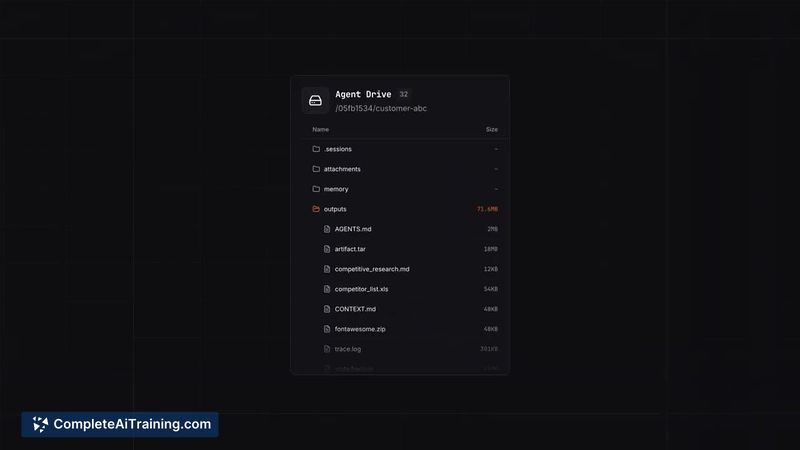
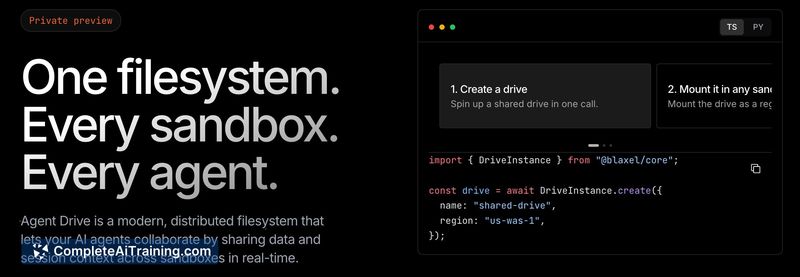
Blaxel Agent Drive tackles a specific friction point in multi-agent workflows: moving artifacts between sandboxes. Teams often build ad-hoc solutions with S3 and locking mechanisms, or they rebuild context between runs. Agent Drive replaces that with a mounted filesystem that looks and behaves like a local path to any agent that connects to it.
Key Features
- Concurrent read-write access across multiple sandboxes through a single distributed filesystem mount
- FUSE-based client with built-in replication that keeps files available after a sandbox session ends
- Hot-attach capability - a drive can be mounted into a sandbox that is already running
- Standard filesystem path interface requiring no special APIs or SDKs for agents to read and write
- Files persist independently of any individual sandbox, so a coding agent's output remains accessible to a review agent in a different sandbox
Pricing and Value
The product is listed as free during the private preview phase. Pricing for general availability has not yet been defined. Teams interested in the preview cohort are asked to describe their multi-agent workflow when requesting access, with priority given to those using a business email.
Pros
- Removes the need for teams to build and maintain custom shared-storage layers with object storage and locking
- Works through a normal filesystem path, which means existing agent tooling doesn't need modification
- Drives attach to already-running sandboxes without restarting or reconfiguring the environment
- Files outlive individual sandbox sessions, cutting out context-rebuilding steps between pipeline stages
- Replication is handled at the infrastructure level rather than requiring application-level coordination
Cons
- Write conflict resolution is currently last-write-wins, so a second agent can read a partially-written file before the first agent finishes writing
- No version control or rollback capability is mentioned in the current implementation - if a write breaks something, there is no built-in undo path
- Not well suited for single-agent setups or teams without multi-sandbox workflows - the network mount adds latency compared to a local volume, which can slow file-heavy operations like code search across repositories
Teams running multi-agent pipelines that hand off code artifacts, tool outputs, dependency caches, or datasets between sandboxes will find the shared filesystem model directly applicable. Session-based locks are on the roadmap, according to the team, but the current last-write-wins behavior means pipelines need their own guardrails around partial reads. For groups that have already strung together object storage and copy scripts, Agent Drive collapses several moving parts into a single mount point.