About Claude Code & Codex Usage Trading Cards by Rudel
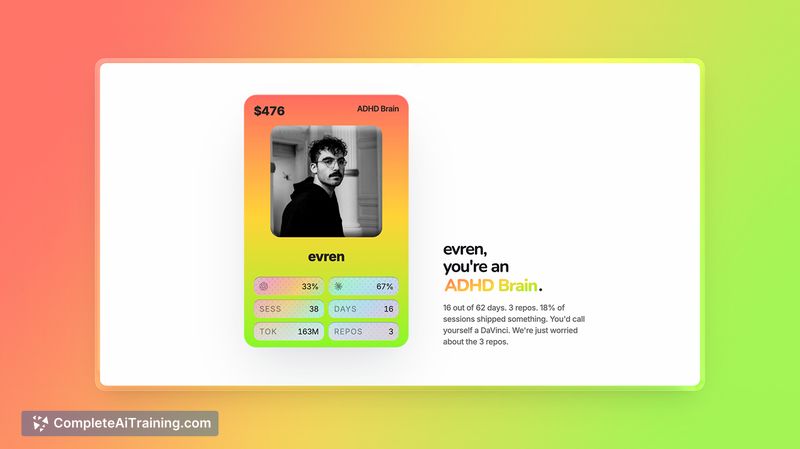
Claude Code & Codex Usage Trading Cards by Rudel converts Claude Code and Codex sessions into a compact, visual summary that labels developers with an archetype based on real usage patterns. It provides session-level analytics-token counts, model mix, error signals and output quality-while remaining free, open source, and self-hostable.
Review
This tool blends practical session analytics with a light, collectible presentation: upload usage data and receive a trading-card-style profile plus behavior metrics. Behind the card is a behavioral classifier trained on roughly 20,000 aggregated sessions that groups users into nine archetypes, giving teams a quick read on how their members are interacting with AI-assisted coding.
Key Features
- Session analytics: token usage, duration, model mix, repo breadth and commit signals aggregated per session.
- Behavioral classifier: archetype assignment based on 20k+ sessions to summarize usage patterns across developers.
- Error and quality signals: highlights where sessions fail or produce low-quality outputs to help triage issues.
- Trading-card presentation: a compact, shareable summary that makes patterns easy to scan at a glance.
- Open source and self-hostable: option to keep session data local or use a hosted offering.
Pricing and Value
Claude Code & Codex Usage Trading Cards by Rudel is offered for free and distributed as open source, with a self-hostable deployment model. That makes it attractive for teams that need to retain control over sensitive session data while still gaining visibility into token spend, session patterns, and where AI assistance helps or hinders development workflows. A hosted/cloud option is also available for teams that prefer not to run infrastructure themselves.
Pros
- Provides a clear stats layer for actual developer behavior with direct metrics like tokens, session shapes, and model mix.
- Behavioral archetypes offer a fast, interpretable summary useful for team retrospectives and onboarding.
- Open source and self-hostable, which is good for teams that must keep telemetry local or prefer code-first tooling.
- Free to try, lowering the barrier for small teams and individual contributors to experiment with usage analytics.
Cons
- Longer-term trend analysis and more opinionated, prescriptive suggestions are limited today and would add practical value.
- Tighter integrations with common dev tooling (CI, code hosts, issue trackers) are currently limited, which can slow adoption for some teams.
- Self-hosting raises questions about resource needs and upgrade/migration practices for larger teams; documentation on scaling could be clearer.
Ideal for developer teams and individual engineers who use Claude Code or Codex and want transparent, local analytics about how AI assistance is being used, spent, and producing output. The trading-card output makes the data approachable for teams that want a quick snapshot, while the open-source, self-hostable option suits groups that prioritize data control and customization.
Open 'Claude Code & Codex Usage Trading Cards by Rudel' Website
Your membership also unlocks: