About CogniMemo
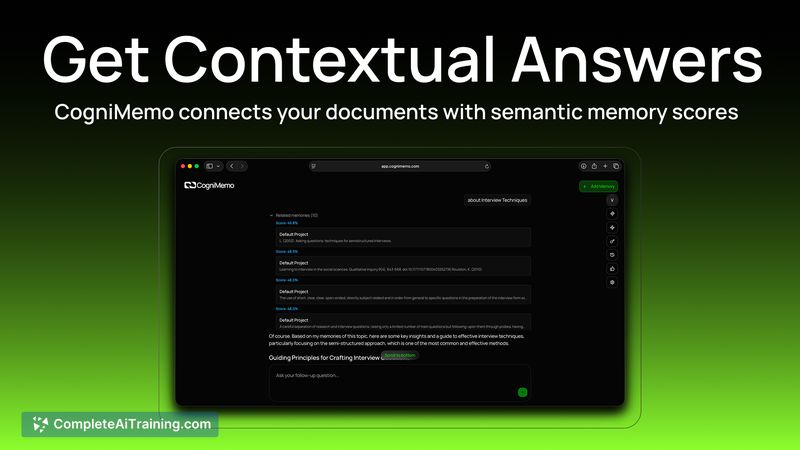
CogniMemo is an API service that gives AI systems long-term memory, allowing them to remember users, preferences, tasks, decisions, and past conversations. It integrates with any LLM (OpenAI, Anthropic, or local models) and aims to provide persistent, context-aware memory without separate infrastructure or embedding setup.
Review
CogniMemo offers a focused solution for one of the common limitations of current AI assistants: short-lived context. By providing a single API that stores and retrieves long-term user memory, it simplifies adding continuity and personalization to assistants, agents, and AI-powered apps. The product is currently in beta and positions itself as an easy-to-integrate memory layer that follows users across tools and workflows.
Key Features
- Long-term persistent memory that stores user details, preferences, tasks, and past interactions.
- Simple API-based integration with no separate infra or embedding pipeline required.
- Compatibility with multiple LLM providers, including OpenAI, Anthropic, and local models.
- Memory that updates and learns from each interaction, making context progressively richer.
- Cross-tool memory that can be applied across different apps and workflows.
Pricing and Value
At launch CogniMemo is offered with a free tier during beta, so developers can experiment without upfront cost. Detailed production pricing is not yet public; expect tiered plans based on usage, memory volume, and API requests as the product matures. The main value proposition is reduced engineering overhead for persistent memory-teams avoid building their own storage, retrieval, and syncing layers-and faster time to prototype personalized assistants. Evaluate actual costs against your expected memory size and query patterns before committing to production usage.
Pros
- Straightforward API that removes the need to manage embeddings or infrastructure for memory.
- Works with multiple LLMs, so you can pick or switch language models without rearchitecting memory.
- Persistent, context-aware memory can improve user experience by reducing repeated setup and reintroduction.
- Cross-application memory means user context can travel across different tools and interfaces.
- Active beta development with an accessible launch presence and community feedback loop.
Cons
- Pricing and rate limits for large-scale production use are not fully detailed yet, creating uncertainty for planning.
- Data governance, privacy, and export controls will be critical for sensitive use cases; documentation on those controls may still be evolving.
- Being in beta, feature completeness and stability may vary compared with mature alternatives.
Overall, CogniMemo is well suited for developers building AI assistants, productivity tools, and agents that benefit from persistent personalization and reduced reintroduction overhead. It is most useful for teams that want a drop-in memory layer to prototype or enhance assistants quickly, and for projects where maintaining continuity across sessions and tools adds clear user value.
Open 'CogniMemo' Website
Your membership also unlocks: