About Compute:Arena
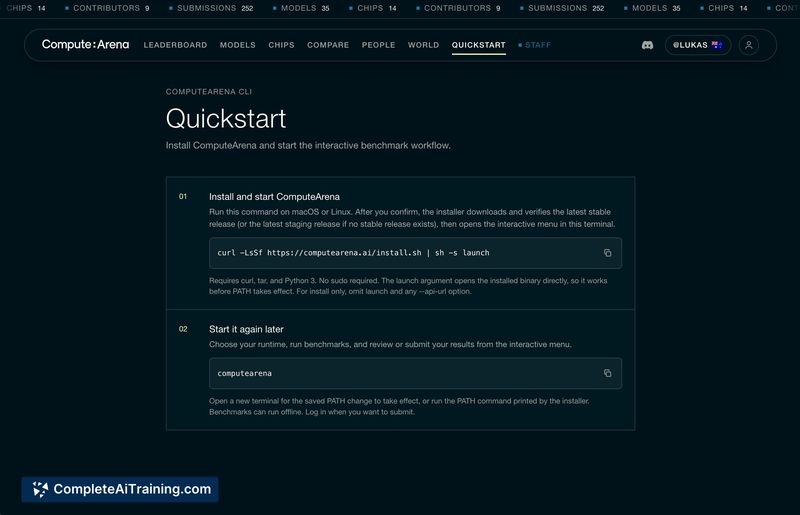
Compute:Arena is a platform for community-submitted performance benchmarks of local AI models. It uses an open-source testing harness that runs on a user's own hardware, measuring how different models perform across various runtimes and quantisation levels. Results are published to a public leaderboard at computearena.ai, covering hardware from AMD, NVIDIA, Apple Silicon, Intel, and Qualcomm.
Review
Compute:Arena addresses a specific friction point for anyone running large language models locally: figuring out actual tokens-per-second on real hardware. The project launched with a few hundred community submissions already on the board, which gives an early signal of what kind of data is accumulating. It's a focused tool-no model training, no deployment management-just benchmarking and comparing.
Key Features
- Open-source testing harness. The same internal tooling the Base Compute team uses to track model and chip performance is available for anyone to run on their own machine.
- Public leaderboard. Submitted results appear at computearena.ai, sortable by model, hardware, runtime, and quantisation method.
- Multi-platform hardware coverage. The harness runs on AMD, NVIDIA, Apple Silicon, Intel, and Qualcomm devices, reflecting the fragmented landscape of local AI inference.
- Community-driven data. All benchmarks come from user submissions rather than a centralized lab, so the dataset grows as more people contribute.
- Quantisation-aware comparisons. Results account for different quantisation levels, letting users see the speed trade-offs for various model compression formats.
Pricing and Value
Compute:Arena is free. The testing harness is open source, and the leaderboard is publicly accessible. There is no mention of paid tiers, enterprise licensing, or API access fees in the current launch materials. Whether a commercial offering will appear later is not yet defined.
Pros
- Eliminates guesswork when choosing a model for a specific hardware configuration by showing real-world throughput numbers.
- Open-source harness means users can inspect the benchmarking methodology or adapt it for their own testing pipelines.
- Supports a wide range of hardware vendors, which is uncommon in a space where many benchmarks default to NVIDIA-only data.
- Quantisation-specific results help users decide whether a 4-bit or 8-bit model is worth the speed difference on their device.
- The leaderboard is already populated at launch, so first-time visitors don't arrive to an empty dataset.
Cons
- As a newly launched project, the dataset is still small-some hardware and model combinations have no submissions yet, which limits coverage for less common setups.
- Community-submitted data introduces variance; different users may have different background processes, cooling conditions, or driver versions that affect results without being documented.
- Compute:Arena is not well suited for users who need managed cloud inference or production deployment metrics-it focuses strictly on local, on-device benchmarking.
Compute:Arena fits neatly into the workflow of developers and hobbyists who run LLMs on their own machines and want to compare hardware before downloading large model files. It's also useful for teams evaluating on-device AI across different chip architectures. The tool's usefulness will depend heavily on how many people contribute benchmarks over time, since sparse data for niche hardware remains the main limitation at this stage.
Open 'Compute:Arena' Website
Your membership also unlocks: