About /dev for Claude Code
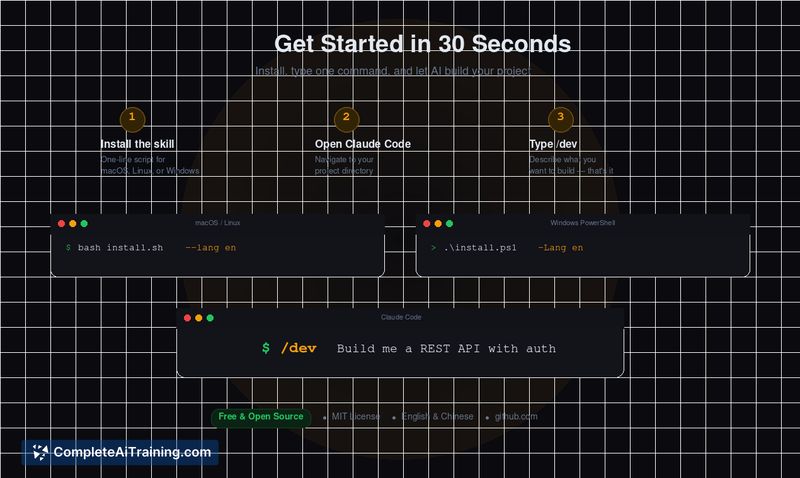
/dev for Claude Code is an open-source MIT-licensed extension that applies a six-phase engineering standard operating procedure to Claude Code. It converts Claude Code's agent capabilities into a Tech Lead-style workflow by running parallel Worker Agents in isolated git worktrees and adding checks for requirements, architecture, QA, security, and safe merges.
Review
/dev for Claude Code targets teams and projects that want stricter engineering discipline around AI-generated code. It layers a rigid process-requirements, architecture, parallel development, QA, code review, and merge-on top of Claude Code's subagent architecture, emphasizing conflict detection, counterexample checks, and mandatory security audits.
Key Features
- Six-phase SOP: PRD alignment, architecture, coding, QA, code review, and iteration to structure development flow.
- Parallel Worker Agents in isolated git worktrees to reduce file overlap and support concurrent workstreams.
- Six-category counterexample self-checks (null, boundary, concurrency, malicious input, etc.) and conflict detection between open issues.
- Pre-merge safety measures including Bandit and npm audit, DB migration guards, and veto conditions for risky changes.
- Open-source (MIT) codebase for inspection, modification, and self-hosting or extension.
Pricing and Value
/dev for Claude Code is free and released under the MIT license, which makes it easy to review, fork, or adapt for internal workflows. The value is strongest for teams that require procedural safeguards and automated checks around AI-driven development; for those teams the overhead can prevent regressions and security issues, but that same overhead may be unnecessary for small, fast-moving tasks.
Pros
- Enforces engineering process steps that many AI-assisted workflows omit, reducing the chance of shipping unchecked code.
- Isolated worktrees and conflict detection help keep parallel work from inadvertently clobbering other changes.
- Built-in counterexample checks and mandatory security scans raise the baseline quality and safety of merges.
- MIT license and open-source sources allow teams to audit and adapt the SOP to their needs.
Cons
- Introduces ceremony and overhead that can slow down simple edits or fast prototyping sessions.
- Relatively early-stage with limited community signal; adoption and polish may be uneven compared with mature workflows.
- The rigid, monolithic process can be less flexible than composable, ad-hoc agent patterns for some users.
Ideal users are engineering teams that use PR-based workflows, need stricter safety and audit controls, and are willing to accept process overhead to reduce risk. It is less suited to solo developers or quick UI/UX iterations where speed and low friction matter more than formal reviews and audits.
Open '/dev for Claude Code' Website
Your membership also unlocks: