About Freesolo Flash
Freesolo Flash is a full-stack platform for training small language models, launched this week. It targets enterprise teams that want to convert generic model capabilities into specialized AI features using post-training loops like supervised fine-tuning (SFT) and reinforcement learning (RL). The platform emphasizes upfront cost quotes and a coding agent-driven workflow.
Review
Freesolo Flash enters a space where many teams find managed post-training solutions costly or unpredictable. Its core idea is to let a coding agent adjust dataset size, model parameters, and algorithms against a known budget before a training run begins. This review examines the product as described in its public launch materials and community discussion.
Key Features
- Upfront pricing: The platform quotes the total cost of a training run before it starts. A coding agent can then tweak variables to stay within budget.
- GPU infrastructure optimization: Freesolo Flash claims training costs are 8x lower for SFT and 5.5x lower for GRPO (RL) when compared to the Tinker platform.
- Environment hub: A custom SDK lets teams build modular environments that integrate with the platform's asynchronous training framework.
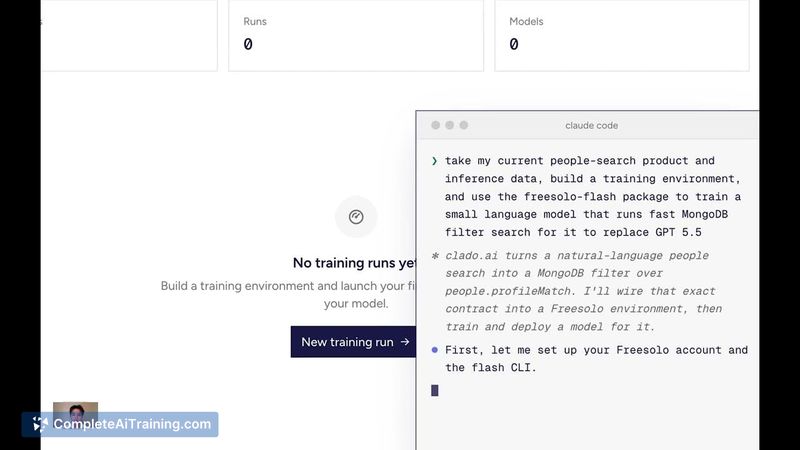
- Agent-driven workflow: Users supply a Freesolo API Key and point a coding agent at the training package to initiate runs.
Pricing and Value
Freesolo Flash does not list a fixed pricing table. The stated model is an upfront quote per run, factoring in dataset, model size, and chosen algorithms. Actual dollar figures are not publicly defined. The value depends on whether quoted prices accurately reflect final costs and whether the claimed savings against other platforms hold across different training scenarios. Community members have asked how overruns-especially on unpredictable RL runs-are handled, but no response has been provided yet.
Pros
- Upfront cost visibility removes the guesswork of per-hour GPU billing.
- Optimized infrastructure aims to lower per-run expenses, with specific comparison numbers published.
- The environment SDK supports modular custom environments, which can simplify RL task setup for developers.
- Integrates with a coding agent workflow, reducing manual configuration steps once the agent is pointed at the package.
- Focuses on small language models (sub-10B parameters), which typically run faster and cheaper in production than large frontier models.
Cons
- Not well suited for teams without a coding agent or developers who can integrate an API. The entire workflow assumes an agent-driven setup.
- The upfront pricing model's handling of runs that exceed initial estimates (e.g., RL convergence requiring more steps) is not clarified, creating uncertainty about final costs.
- The 8x and 5.5x cost savings claims relative to Tinker are not accompanied by a detailed comparison methodology, making independent verification difficult.
Freesolo Flash may fit development teams that already use coding agents and need to fine-tune small models for narrow, high-volume tasks like tagging or search. The upfront pricing and agent-driven approach could lower the barrier to RL training for those with the technical skills to set it up. Teams without an API-based agent workflow, or those requiring strict data residency guarantees, will likely need more information before evaluating the platform.
Open 'Freesolo Flash' Website
Your membership also unlocks: